

Links for today’s readings:
Nov 5 Read: Ezekiel 36 Listen: (6:40) Read: Titus 2 Listen: (2:01)
Scripture Focus: Ezekiel 36.26-27
I will give you a new heart and put a new spirit in you; I will remove from you your heart of stone and give you a heart of flesh. And I will put my Spirit in you and move you to follow my decrees and be careful to keep my laws.
Reflection: The Radical Procedure of the Gospel
By John Tillman
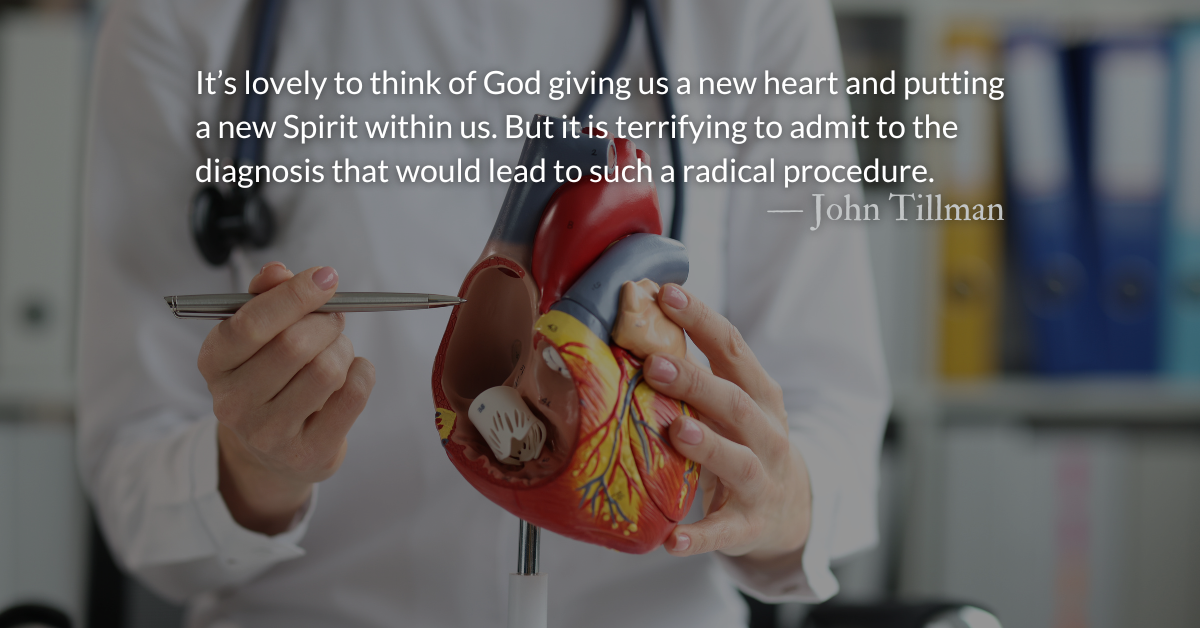
It’s lovely to think of God giving us a new heart and putting a new Spirit within us. But it is terrifying to admit to the diagnoses that would lead to such a radical procedure.
Our familiarity with miraculous examples of modern medicine has muddied this concept for us. Ezekiel wasn’t thinking of a sterile operating room where doctors replace a ten-pound chunk of muscle. As radical as cracking open someone’s chest is, Ezekiel’s concept of God replacing our heart is more extreme.
The biblical language isn’t referring to the heart in either the medical or emotional sense. When the Bible talks about the heart, it refers to our complete “inner being,” not any one organ or one part. It refers to our central, inner self. It is our spirit, mind, and emotions.
In the Bible, the heart, whether of a country or one person, is that which is central and vital, without which, meaning and purpose are lost. This is the heart that Ezekiel says is irreparable and dead and must be replaced.
A spiritually relevant question to ask would be, “How did it get that way?”
Israel’s heart was hardened by their determined pursuit of idols of wealth and power at the expense of the poor and the unfortunate. God repeatedly says through Ezekiel that they have caused “bloodshed” in the land. Ezekiel is clear that this means enriching themselves by directly and indirectly causing the deaths of the voiceless, the weak, and the powerless.
Repeated uncaring actions. Repeated justifications of wrongdoing. Repeatedly using legalism to escape our responsibility to others. Repeatedly taking advantage and accepting the benefits of advantages given to us.
This repeated friction as we strain against God’s promptings creates calluses, roughening hearts intended to be tender. These heart-hardening steps tread the path to exile. These are the actions of those whose idols are leading them to be insensitive to God’s voice, to be unmoved by God’s spirit.
After the shockingly violent and bloody experience Jesus undertook to make this transplant possible, he quietly comes to his disciples to begin the procedure. There in the upper room, he intimately prays a simple prayer that would not be answered for nearly fifty days: “he breathed on them and said, ‘Receive the Holy Spirit.’” (John 20.22)
May this prayer of Christ be made real in our lives. May our hearts be made sensitive enough to feel his breath, hear his voice, and move as he directs.
Divine Hours Prayer: The Greeting
My heart is firmly fixed, O God, my heart is fixed; I will sing and make melody. — Psalm 57.7
– From The Divine Hours: Prayers for Autumn and Wintertime by Phyllis Tickle.
Read more: Choices and Hard Hearts
Hardened hearts happen in stages. Do we hear and obey? Our heart will grow softer…
Do we hear and turn away? Our heart will grow harder…
Read more: Judging Our Hearts
The most often quoted portion of Matthew’s seventh chapter is probably it’s first three words: “Do not judge.” Most people stop there.

