

Links for today’s readings:
Nov 20 Read: Daniel 3 Listen: (5:56) Read: Hebrews 1 Listen: (2:15)
Links for this weekend’s readings:
Nov 21 Read: Daniel 4 Listen: (7:27) Read: Hebrews 2 Listen: (2:47)
Nov 22 Read: Daniel 5 Listen: (5:47) Read: Hebrews 3 Listen: (2:25)
Scripture Focus: Daniel 3.8-12
8 At this time some astrologers came forward and denounced the Jews. 9 They said to King Nebuchadnezzar, “May the king live forever! 10 Your Majesty has issued a decree that everyone who hears the sound of the horn, flute, zither, lyre, harp, pipe and all kinds of music must fall down and worship the image of gold, 11 and that whoever does not fall down and worship will be thrown into a blazing furnace. 12 But there are some Jews whom you have set over the affairs of the province of Babylon—Shadrach, Meshach and Abednego—who pay no attention to you, Your Majesty. They neither serve your gods nor worship the image of gold you have set up.”
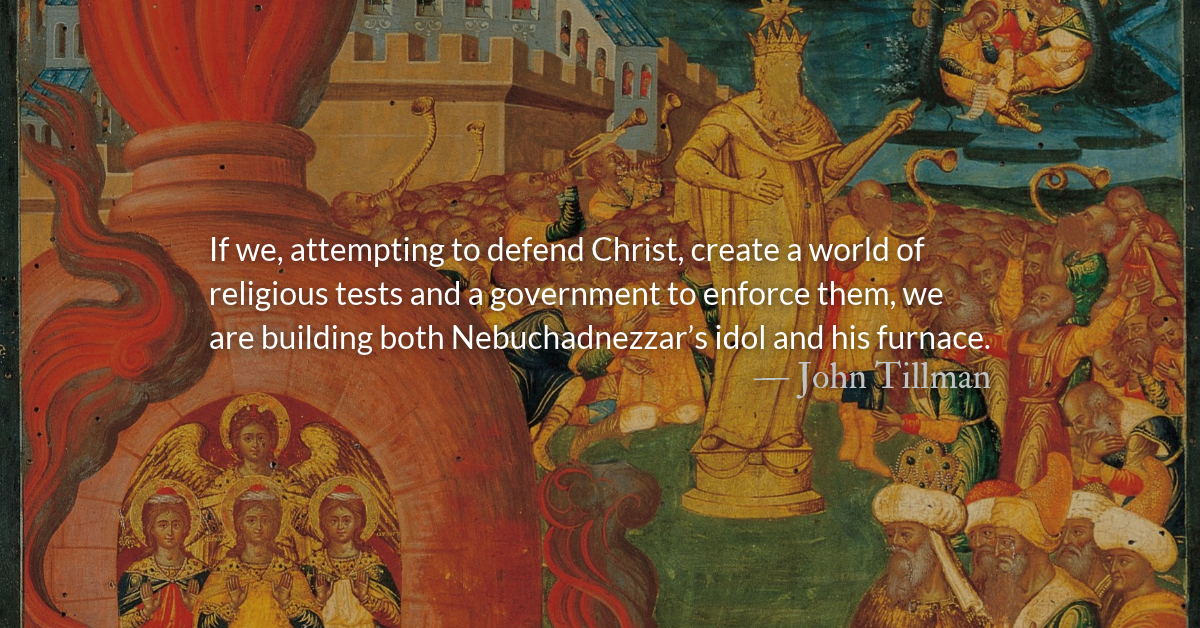
Image: “The story of Daniel and the Three Youths in the Fiery Furnace,” by Adrianoupolitis Konstantinos, 1725-1750
Reflection: The Tests of the Furnace
By John Tillman
In my life, Daniel 3 has often been used to warn against anti-Christian governments.
Many pastors and speakers warned that dangerous political forces will one day force a Nebuchadnezzar-like choice and I needed to pass the test of the furnace.
I don’t disagree it is possible. History says so. Yet, I have found that idols don’t often meet my expectations and I’m unprepared for how deceptive they can be. In a way, the three Hebrew officials had it easy. Their choice was emotionally devastating but morally obvious. If you put a gun to my head and demand I renounce Jesus, there’s no ambiguity about what I should do, whether or not I have the courage to do it.
Idols are not usually as blatant as Nebuchadnezzar’s statue. And when things that look like Nebuchadnezzar’s statue appear in modern times, people often write them off as jokes or defend or approve of them anyway. Whether or not particular golden statues are idols, the demands of idolatry are typically more subtle and not always explicitly religious.
Modern idols don’t say, “Worship Mammon (or Aphrodite).” They say, “It’s your money (or your body). You can do what you want.” When idols make demands or claims, they are often about others. “You aren’t hurting anyone.” “They have no right to criticize you.” “They don’t belong here.” “We are better than they are.” “Protect me from them.” We know Dagon was an idol, because every time he fell down, worshipers had to set him back up (1 Sam 5.3-4).
I have found that Christians are susceptible to the “defend me” message of some idols. When our idols fall morally, we want to set them back up. We also are susceptible to the temptation to think Jesus needs our defense and that our public servants must pass a religious test.
If we, attempting to defend Christ, create a world of religious tests and a government to enforce them, we are building both Nebuchadnezzar’s idol and his furnace. Eventually, like the officials thrown to the lion’s den (Dan 6.24), the evil we planned for others will be turned against us.
Christians are supposed to be the exiles in the persecution narratives of Daniel, not the kings and officials demanding religious submission. I was warned about not submitting to Nebuchadnezzar. I was not sufficiently warned against becoming him. An additional test of the furnace is whether we will cast others into it.
Divine Hours Prayer: The Greeting
You are the Lord, most high over all the earth; you are exalted far above all gods. — Psalm 97.9
– From The Divine Hours: Prayers for Autumn and Wintertime by Phyllis Tickle.
Read more: To Assimilate or Not
Stories of bold resistance and quiet acceptance reveal the complexity of life…boldness in refusing the king and boldness in obeying.
Read more: Stories of Faith :: A Guided Prayer
We should not forget that even though Shadrach, Meshach, and Abednego survived the furnace, they still died in exile. This world is not our home.

