

Links for today’s readings:
Jan 19 Read: Job 20 Listen:(2:52) Read: John 19 Listen: (6:23)
Scripture Focus: John 19.4-16
4 Once more Pilate came out and said to the Jews gathered there, “Look, I am bringing him out to you to let you know that I find no basis for a charge against him.” 5 When Jesus came out wearing the crown of thorns and the purple robe, Pilate said to them, “Here is the man!” 6 As soon as the chief priests and their officials saw him, they shouted, “Crucify! Crucify!” But Pilate answered, “You take him and crucify him. As for me, I find no baszis for a charge against him.” 7 The Jewish leaders insisted, “We have a law, and according to that law he must die, because he claimed to be the Son of God.” 8 When Pilate heard this, he was even more afraid, 9 and he went back inside the palace. “Where do you come from?” he asked Jesus, but Jesus gave him no answer. 10 “Do you refuse to speak to me?” Pilate said. “Don’t you realize I have power either to free you or to crucify you?” 11 Jesus answered, “You would have no power over me if it were not given to you from above. Therefore the one who handed me over to you is guilty of a greater sin.” 12 From then on, Pilate tried to set Jesus free, but the Jewish leaders kept shouting, “If you let this man go, you are no friend of Caesar. Anyone who claims to be a king opposes Caesar.” 13 When Pilate heard this, he brought Jesus out and sat down on the judge’s seat at a place known as the Stone Pavement (which in Aramaic is Gabbatha). 14 It was the day of Preparation of the Passover; it was about noon. “Here is your king,” Pilate said to the Jews. 15 But they shouted, “Take him away! Take him away! Crucify him!” “Shall I crucify your king?” Pilate asked. “We have no king but Caesar,” the chief priests answered. 16 Finally Pilate handed him over to them to be crucified.
Reflection: Principles Under Pressure
By John Tillman
The gospel accounts emphasize Pilate was pressured to crucify Jesus. The creeds name him as the authority who crucified Jesus.
Some claim Pilate tried to save Jesus. (This is sometimes a bad-faith argument motivated by anti-semitism.) Some see Pilate as the villainous stand-in for wicked governments of today. Which is it? Is Pilate “innocent of this man’s blood” or Jesus’ villainous killer?
Some Westerners think fondly about Rome as if it was a utopia. Some of our democratic principles germinated in Rome, but it took millennia before they flowered. Rome, even in the best of times, was not the idyllic bastion of freedom and democracy some pretend.
Rome had a legislature and courts, but they were neutered. Rome’s senate ceased to function long before it ceased to exist. Citizens had the barest minimum of rights but citizens were few and far between. The majority of Rome’s population were subjects and slaves, not citizens. And rulers could do with subjects whatever they wanted. Rome was an autocratic empire robed in the costume of a republic. Governments like this still exist today.
Caesar ruled with impunity and this attitude of unaccountability trickled down to those under his authority. As long as you kept Caesar happy, you could do whatever you wanted to your subjects. Slaughter them, imprison them, tax them, oppress them.
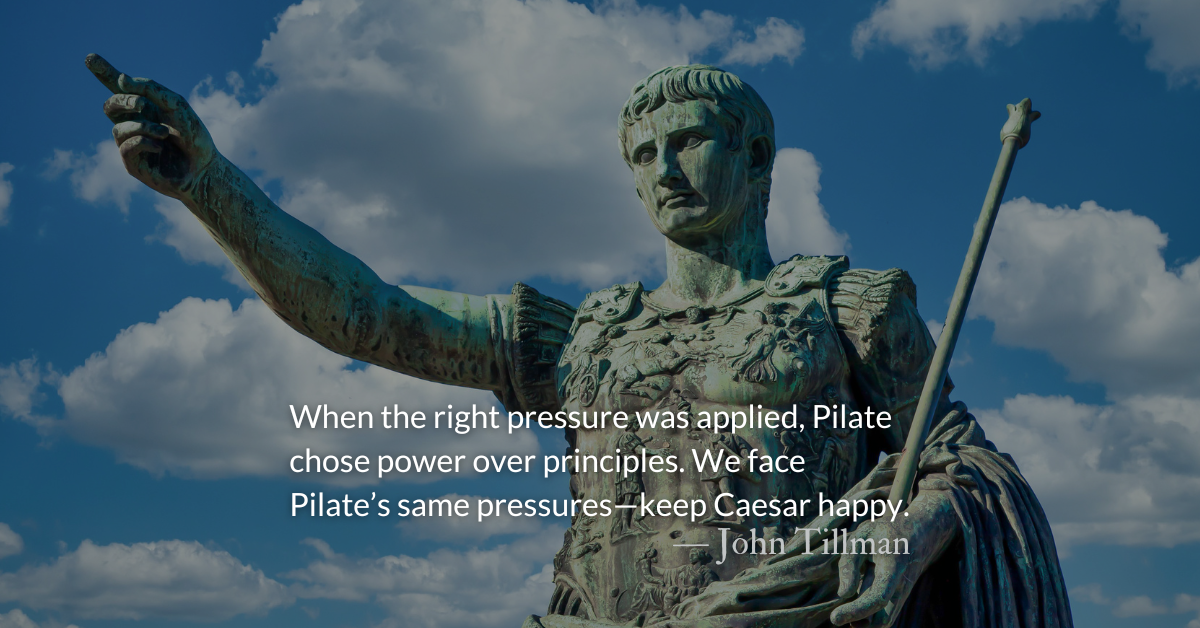
On paper, Pilate had all the power. He could do whatever he wanted. Pilate seems to have been a principled person who wanted to judge rightly and uphold the law. But when the right pressure was applied, Pilate chose power over principles.
We face Pilate’s same pressures—keep Caesar happy. Caesar’s forces today might be political, religious, relational, or career-related. We might fear loss of power, ostracization, career losses, or violence. Many will weaponize those forces and fears to manipulate us.
The religious leaders manipulated Pilate saying, “If you let this man go, you are no friend of Caesar.” What might this look like for us? “If you ___________, you are no ___________.” What goes in those blanks? Who’s your Caesar? Who threatens Caesar’s disapproval? What principles does Caesar demand you sacrifice? What injustices does Caesar expect you to ignore or defend?
Under pressure, respond like Jesus, not Pilate. Recognize that they don’t truly have power over us. Even if harmed, we know we share in Christ’s sufferings and rise in his power.
Resist pleasing Caesar by submitting to Christ.
Divine Hours Prayer: The Greeting
O God, you have taught me since I was young, and to this day I tell of your wonderful works. — Psalm 71.17
– From The Divine Hours: Prayers for Autumn and Wintertime by Phyllis Tickle.
Read more: Hounding the Wounded
Job is in pain, suffering physically, emotionally, and spiritually but his friends treat him as a spiritual enemy.
Read more: The King We Want
We want a king, we say
To cast out the unworthy
Keep away those we despise and fear
Isolate us with those we hold dear