Two-Item Wishlist

Links for today’s readings:

Aug 5  Read: Isaiah 65 Listen: (5:00) Read: Psalms 142-143 Listen: (2:35)

Scripture Focus: Psalm 143:8

8 Let the morning bring me word of your unfailing love,
    for I have put my trust in you.
Show me the way I should go,
    for to you I entrust my life.

Reflection: Two-Item Wishlist

By Erin Newton

In 1 Kings 19, there is a story of an exhausted and downtrodden prophet, Elijah. Fleeing from Ahab and Jezebel, who sought to kill him, he cries out to God, “I have had enough, Lord. Take my life.” But he lies down and falls asleep. An angel wakes him to say, “Get up and eat.” So he eats the divinely supplied bread and water…then goes back to bed. The nap and meal repeat a second time, finally restoring Elijah with energy and hope for the next task.

When decisions seem overwhelming, we often suggest someone should “sleep on it.” We might even cry ourselves to sleep during times of deep sadness. Cranky children are told to take a nap. Our sluggish thinking and snippy attitudes are blamed on a bad night of sleep.

We know that sleep is good for us. But what about the hope of the coming morning? Isn’t that sometimes even more encouraging?

I love this verse for the fact that the night is still assumed. The psalmist is weary from his or her day. Maybe she is existentially exhausted (a phrase I’ve used just this past week). Maybe he is being wrongfully accused or purposely bullied.

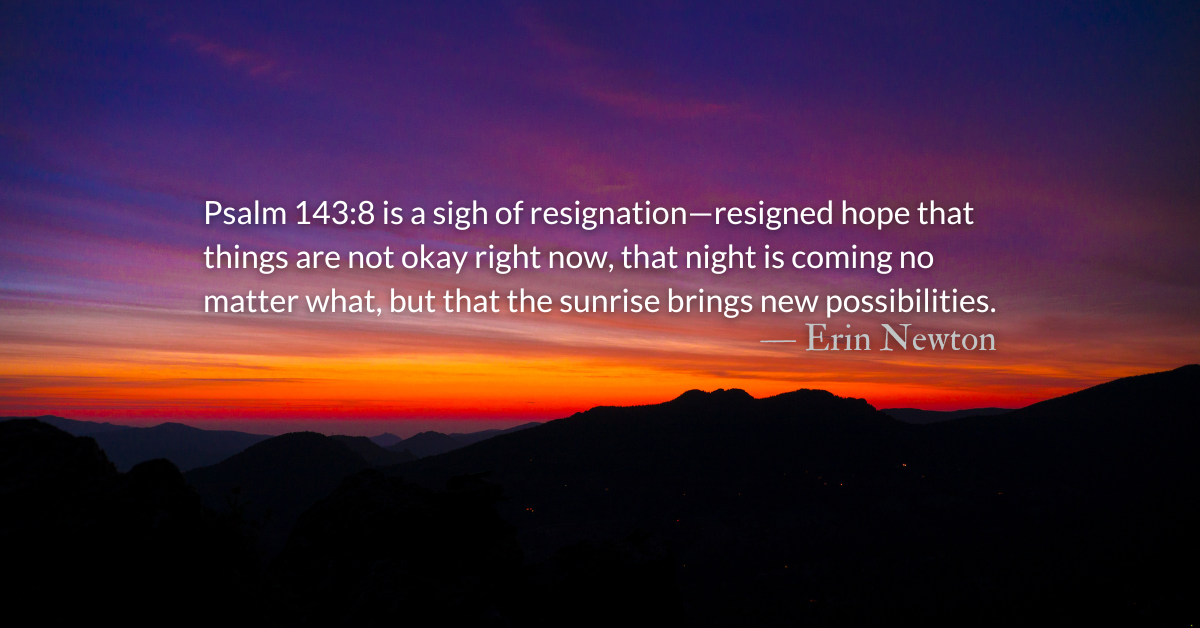
Psalm 143.8 is a sigh of resignation—resigned hope that things are not okay right now, that night is coming no matter what, but that the sunrise brings new possibilities. Maybe I’ll feel the love of God tomorrow.

I try to begin my days asking God to make himself known to me, especially when I wake up knowing it will be full of dreaded appointments, hard conversations, and unmet expectations. When I drove to the high-risk pregnancy doctor back in 2016, my only prayer was that I would feel God’s presence in that room. That would sustain me. That would be enough to help me endure.

The psalmist asks for two things: Let me know you love me. Show me what to do. We could live our whole lives just asking God for these two things. A two-item wishlist.

The two requests also function fairly well alone. I can rest in God’s love for me when I do not know what to do or where to go. I can also do what God calls me to do with gritted teeth, not feeling God’s love very clearly at that moment.

When the next sunrise comes, ask God for these two things—love and guidance.

Divine Hours Prayer: The Request for Presence

Show your goodness, O Lord, to those who are good and to those who are true of heart. — Psalm 125.4

– From The Divine Hours: Prayers for Summertime by Phyllis Tickle.

Read more: Unprecedented Spirit

The very Spirit promised in Joel and poured out in Acts is a deposit, a guarantee, of the inheritance God has for each of us in Christ.

Read more: When Celebrating Earthly Kingdoms

No matter our country or party, by echoing jingoistic patriotic divisiveness we risk diluting the gospel of Christ.

From the Manger to the Muddy Jordan

Links for today’s readings:

Dec 26   Read: 2 Chronicles 31 Listen: (4:20) Read: Psalms 142-143 Listen: (2:35)
Dec 27   Read: 2 Chronicles 32 Listen: (5:58) Read:  Psalms 144 Listen: (1:56)
Dec 28   Read: 2 Chronicles 33 Listen: (4:01) Read:  Psalms 145 Listen: (2:19)

Scripture Focus: Psalm 143:8-10

8 Let the morning bring me word of your unfailing love,
    for I have put my trust in you.
Show me the way I should go,
    for to you I entrust my life.
9 Rescue me from my enemies, Lord,
    for I hide myself in you.
10 Teach me to do your will,
    for you are my God;
may your good Spirit
    lead me on level ground.

Mark 1:1-8

1 The beginning of the good news about Jesus the Messiah, the Son of God, 2 as it is written in Isaiah the prophet:

“I will send my messenger ahead of you,
    who will prepare your way”—
3 “a voice of one calling in the wilderness,
‘Prepare the way for the Lord,
    make straight paths for him.’”

4 And so John the Baptist appeared in the wilderness, preaching a baptism of repentance for the forgiveness of sins. 5 The whole Judean countryside and all the people of Jerusalem went out to him. Confessing their sins, they were baptized by him in the Jordan River. 6 John wore clothing made of camel’s hair, with a leather belt around his waist, and he ate locusts and wild honey. 7 And this was his message: “After me comes the one more powerful than I, the straps of whose sandals I am not worthy to stoop down and untie. 8 I baptize you with water, but he will baptize you with the Holy Spirit.”

Reflection: From the Manger to the Muddy Jordan

By Jon Polk

What’s next now that Jesus’ birth has been celebrated, the presents have been unwrapped, and the leftover turkey and cranberry sauce is almost all gone? How do we leave Christmas behind and move forward into a new year?

Well, what’s next in the gospels? After the birth of Jesus, the next major character introduced is John the Baptist. In Mark’s Gospel, there is no account of the Nativity at all; we jump right into John’s story from the start. 

John is an interesting character. He is identified as the messenger prophesied by Isaiah who would come to prepare the way for the Messiah, but it makes you wonder about Jesus’ PR strategy if this is the guy who is supposed to be his opening act. Living like a wild man out in the Judean wilderness, wearing some uncomfortable threads…and what about that questionable diet of insects and honey? This guy isn’t getting invited to any black-tie charity dinners at the Jerusalem Ritz-Carlton.

Yet, John’s message hit home. People flocked out to the countryside in droves to hear him preach.

John’s message was two-fold. First, he calls people to repentance for forgiveness of sins. By repentance, he doesn’t mean a polite admission of feeling sorry for our sins; he means turning our lives around, leaving our sins behind, and charting a new path. Repentance is about changing how we live in this world, treating one another with the same love and grace God extends to us.

In the second part of his message, John truly understands his place as a voice crying in the wilderness, a lowly servant. He preaches about One coming who is powerful and who will breathe life into them through the Holy Spirit. John’s role is to announce his arrival and prepare the hearts of the people to receive him. Dunking them in the muddy Jordan River is only a precursor to the real change to come when Jesus hits the scene. 

Jesus is this powerful One, but he also is a servant. He isn’t an invincible warrior who vanquishes his enemies with his sword. This powerful One will die a powerless death on a cross, reconciling us with God so that we truly can repent and be forgiven. John the Baptist is the messenger who prepares the way of the Lord and he is a model for our calling as Christians today. Our purpose, like John’s, is to share the Good News, preparing the hearts of others to receive Jesus as King.

That sounds like a good plan to take into the new year.

Divine Hours Prayer: The Call to Prayer

Hallelujah! Praise the Lord, O my soul! I will praise the Lord as long as I live; I will sing praises to my God while I have my being. — Psalm 146.1

– From The Divine Hours: Prayers for Autumn and Wintertime by Phyllis Tickle.

Consider Supporting Our Work

Has our writing helped you this year? Consider helping us produce another 100K of ad-free biblical devotionals (and more) by becoming a donor.

Read The Bible With Us

Give your friends a second Christmas gift by reading the Bible with them in the next year. Have them join you in our sustainable, two-year-paced Bible reading plan..

https://mailchi.mp/theparkforum/m-f-daily-email-devotional

Show Buttons
Hide Buttons
Spur a spiritual rhythm of refreshment right in your inbox
By joining this email list you are giving us permission to send you devotional emails each weekday and to communicate occasionally regarding other aspects of the ministry.
100% Privacy. We don't spam.