Pondering the Plague

Scripture Focus: Exodus 12.28-32
28 The Israelites did just what the Lord commanded Moses and Aaron. 
29 At midnight the Lord struck down all the firstborn in Egypt, from the firstborn of Pharaoh, who sat on the throne, to the firstborn of the prisoner, who was in the dungeon, and the firstborn of all the livestock as well. 30 Pharaoh and all his officials and all the Egyptians got up during the night, and there was loud wailing in Egypt, for there was not a house without someone dead. 

31 During the night Pharaoh summoned Moses and Aaron and said, “Up! Leave my people, you and the Israelites! Go, worship the Lord as you have requested. 32 Take your flocks and herds, as you have said, and go. And also bless me.” 

Reflection: Pondering the Plague
By John Tillman

Pharaoh released the Israelites and asked Moses for a blessing. Previously, Pharaoh threatened his life if Moses ever saw his face again. What happened in between is the tenth plague… 

No one has all the answers to difficult passages like this one. Even if we did, 400 words wouldn’t cover them. Today, we aren’t giving answers. We are asking questions. Some questions refer to the scripture and some to our hearts. Ponder these questions and additional questions of your own in prayer.

It’s not enough to simply say, “Well, the Egyptians deserved it. They are oppressors.” Moses is a genocide survivor. Moses’s Pharaoh is likely the son of the ruler who killed many young men of Moses’s age. A generation of his peers was wiped out. Now the nation that killed that generation would lose a generation of its own. Yet, instead of being satisfied or happy about this, Moses leaves “hot with anger” after announcing the plague. (Exodus 11.8) Why? Who is Moses angry with? Why isn’t retributive justice enough? Why doesn’t “an eye for an eye” satisfy?

What makes you “hot with anger”? Do you celebrate your enemy’s pain and suffering?

Moses survived Egypt’s slaughter of innocents. Jesus escaped Herod’s slaughter of innocents by fleeing to Egypt. The same nation that wiped out a generation of Israelites sheltered Jesus when his life was threatened. They played their part in bringing the gospel to the world and later became a bastion of Christianity in Africa.

Is there anyone/anything you have written off as irredeemable that may still have a part to play to benefit the gospel?

Over and over, Pharaoh was tested and warned of escalating disasters that proved true every time. Surely Pharaoh thought of his son when Moses announced the plague. Why did Pharaoh not believe? Why did he not give in?

Is there anything about which you are refusing to submit to God?

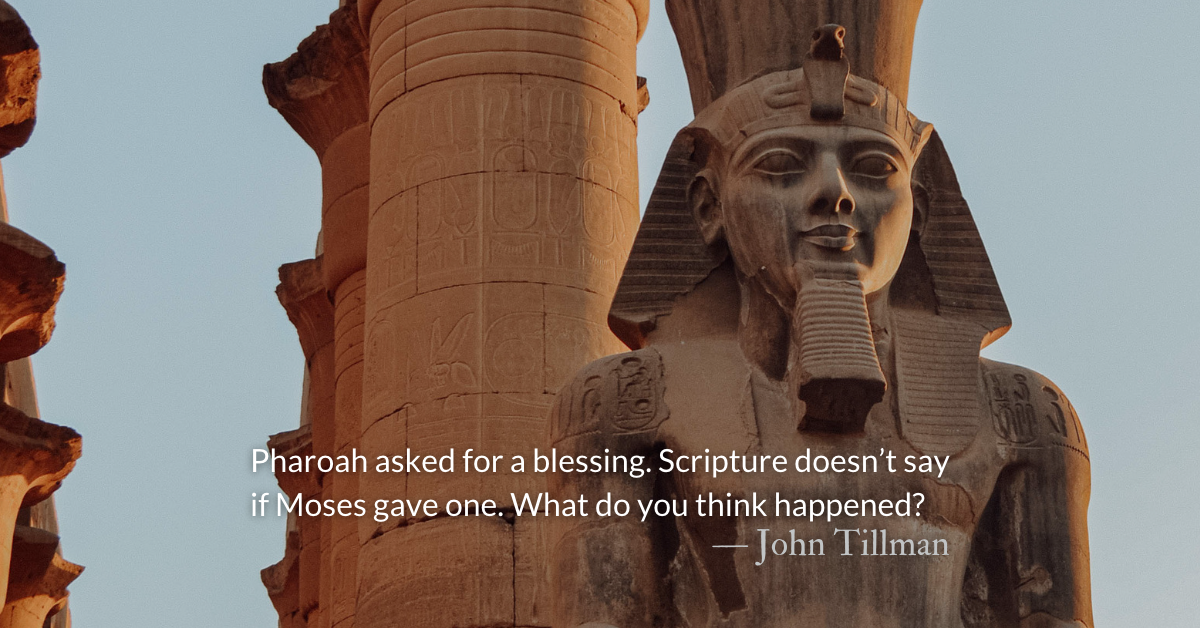
After all this conflict, and especially after losing his son, why would Pharaoh ask for a blessing from Moses? Next to Pharaoh’s request, the Logos Bible I use has a link to Genesis 27.34 in which Esau cries out for a blessing from his father. These two moments are connected. Pharaoh asked for a blessing. Scripture doesn’t say if Moses gave one. What do you think happened?

Is there anyone from whom you are withholding a blessing?

Divine Hours Prayer: The Request for Presence
Show your goodness, O Lord, to those who are good and to those who are true of heart. — Psalm 125.4

Today’s Readings
Exodus 11-12.21 (Listen 9:08) 
Matthew 22 (Listen 4:56)

Read more about Idol-Destroying Plagues
The plagues systematically and categorically destroyed everything that Egypt trusted in and worshiped.

Read more about Testing Before Judgment
The slowly escalating nature of the plagues provides Pharaoh with off-ramps to escape further judgment.

Blessed are the Troublemakers

Scripture Focus: Exodus 10.28-29
28 Pharaoh said to Moses, “Get out of my sight! Make sure you do not appear before me again! The day you see my face you will die.” 
29 “Just as you say,” Moses replied. “I will never appear before you again.”

Reflection: Blessed are the Troublemakers
By John Tillman

The Pharaoh of Joseph’s day had been personally blessed and prayed for by Israel himself. While Israel’s children lived there, Egypt enjoyed the blessings of God and was a channel of God’s blessing to the world.

Any nation that simply allows God’s people to flourish can be so blessed. Even the evil nations of Assyria and Babylon, when they acknowledged the God of the Hebrews among them, were blessed. But any nation, even the nation of Israel or a nation calling itself a “Christian Nation,” can become a nation of cursings instead of blessings. 

Moses’s Pharaoh treated him like an irritant. From a certain perspective, it’s understandable. Moses was demanding. He inconvenienced the privileged life to which Egypt was accustomed. He destroyed the peace. He disrupted the economy. He upended the established order. Pharaoh considered him a troublemaker. 

But Moses was not a troublemaker in Egypt any more than Elijah was a troublemaker in Ahab’s Israel. (1 Kings 18.16-18) In both countries, prophets brought correction through words, demands, and demonstrations of power. It was the leaders who were the troublemakers and made decisions that led toward certain disasters.  

Reading the progression of the plagues and the responses of Pharaoh is like watching a classic tragedy, like Macbeth. He makes horrible choice after choice after choice. We don’t understand how, in the face of so much evidence of God’s power, Pharaoh could still stiffen his neck, harden his heart, and refuse to give in.

Every time we have “trouble” it doesn’t mean God is displeased with us. Sometimes, as Moses did, we will experience “good trouble” when we are doing the right thing. But it is always good to pause and consider if we are “going Pharaoh.”

Moses was a visitation of grace, an opportunity for change. Pharaoh rejected it. Even his leaders realized that Egypt was falling to ruin but he wouldn’t give in to them either. (Exodus 10.7)

We don’t have to look far in the news headlines to see autocratic leaders, bringing their countries to ruin by stubbornly refusing to abandon foolish directions. We don’t have to look far in our own hearts to find moments we resist or resent calls for change that God puts in our path.

Blessed are the troublemakers who demand justice. We should have the humility not to treat them as irritants, but consider whether the source of trouble might instead be our own hearts.

Divine Hours Prayer: The Small Verse
Open, Lord, my eyes that I may see.
Open, Lord, my ears that I may hear.
Open, Lord, my heart and my mind that I may understand.
So shall I turn to you and be healed.

Today’s Readings
Exodus 10 (Listen 4:44) 
Matthew 21 (Listen 7:10)

Read more about The Ram and the Cornerstone
He rammed his teaching into the foundations of the religious leaders’ security and pride, knowing what their violent response would be.

Read more about Ahab and David
Rather than the friendly relationship David had with God and his prophets, Ahab considers Elijah his “enemy.”

What We Loose On Earth

Scripture Focus: Matthew 18.3-7, 10, 18-20
3 And he said: “Truly I tell you, unless you change and become like little children, you will never enter the kingdom of heaven. 4 Therefore, whoever takes the lowly position of this child is the greatest in the kingdom of heaven. 5 And whoever welcomes one such child in my name welcomes me. 

6 “If anyone causes one of these little ones—those who believe in me—to stumble, it would be better for them to have a large millstone hung around their neck and to be drowned in the depths of the sea. 7 Woe to the world because of the things that cause people to stumble! Such things must come, but woe to the person through whom they come!

10 “See that you do not despise one of these little ones. For I tell you that their angels in heaven always see the face of my Father in heaven.

18 “Truly I tell you, whatever you bind on earth will be bound in heaven, and whatever you loose on earth will be loosed in heaven. 

19 “Again, truly I tell you that if two of you on earth agree about anything they ask for, it will be done for them by my Father in heaven. 20 For where two or three gather in my name, there am I with them.”

Reflection: What We Loose On Earth
By John Tillman

I grew up in churches that didn’t just pray for revival but planned them. A joke I often heard from preachers at revivals was that “Like taking a bath every day, we have a revival every year, whether we need it or not.” 

This joke acknowledges the awkwardness that an event on the calendar can be called a revival, but that doesn’t make it so. Calling these meetings “revivals” was aspirational. Revival was what we hoped for.

The term “revival” has often been tainted by unscrupulous, charlatan preachers of the past. Today politicians co-opt the term for political fundraisers which have little to do with the Spirit of God.

Though we can’t put revival on a calendar and we can’t remove the stain of past abuses of the term, it doesn’t mean the genuine article doesn’t exist. A revival movement with all the marks of being genuine sparked at Asbury University in Kentucky on February 8th. 

After that day’s chapel service, a spontaneous, round-the-clock time of prayer, singing, and testimony began. This was led and continued not by plans or schedules but by the hearts of students who were moved to do so. As I write this on Tuesday evening, the continuous service on campus is scheduled to end on Friday, the day this devotional will post. Services are currently being planned to continue in other locations and “The Outpouring,” as it was called, has inspired similar events at churches and other college campuses across the United States.

Many people hearing of this responded with hope but many responded with cynicism. Cynicism is just as lazy as naïveté. Neither requires thoughtful evaluation. 

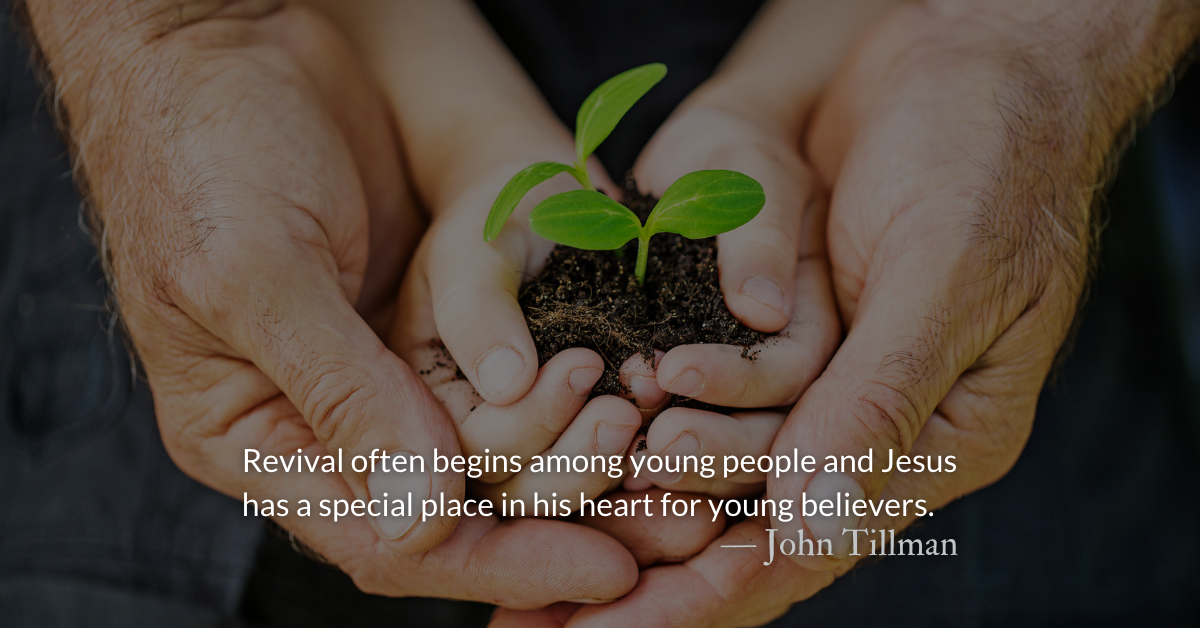
We would be wise not to do anything to make these young followers of Christ stumble. Revival often begins among young people and Jesus has a special place in his heart for young believers. (Matthew 18.6, 10) Instead of doubting these young people and quenching their spirits, (1 Thessalonians 5.19-22) perhaps we should become like them. Instead of sniping from the sidelines, “Nothing will come of this.” We should pray fervently, “God, use this for your glory!”

Many great movements of God can be traced back to experiences such as the one at Asbury. We should not seek to copy-paste the Asbury experience into our communities. But we should seek God’s face, asking him to loose his Spirit on earth in our community in his own unique fashion. (Matthew 18.18)

Divine Hours Prayer: The Call to Prayer
Bless our God, you peoples; make the voice of his praise to be heard;
Who holds our souls in life, and will not allow our feet to slip. — Psalm 66.7-8

Today’s Readings
Exodus 7 (Listen 3:29) 
Matthew 18 (Listen 3:46)

This Weekend’s Readings
Exodus 8 (Listen 5:07) Matthew 19 (Listen 4:04)
Exodus 9 (Listen 5:31) Matthew 20 (Listen 4:22)

Read more about Josiahs Need Zephaniahs
Josiah implemented…the most complete and remarkable revival in Judah’s history.

Read more about A Responsive Heart
Josiah’s revival was unlike anything seen before. No king ever repented and turned back to God like Josiah.

Circumstances Matter

Scripture Focus: Exodus 6.6, 9
6 “Therefore, say to the Israelites: ‘I am the Lord, and I will bring you out from under the yoke of the Egyptians. I will free you from being slaves to them, and I will redeem you with an outstretched arm and with mighty acts of judgment…

9 Moses reported this to the Israelites, but they did not listen to him because of their discouragement and harsh labor. 

Reflection: Circumstances Matter
By John Tillman

The people believed and accepted Moses at first, but then the suffering increased. (Exodus 5.19-23)

After Moses spoke to Pharaoh, Pharaoh cracked down hard on the people, repeatedly calling them “lazy.” (Exodus 5.17) Oppressors often accuse those longing for freedom of being lazy. It is a well-worn argument and, usually, an ironic one. 

In Pharaoh’s case, the Israelites had been doing the hard labor in Egypt for generations. If anyone was lazy, it was Pharaoh and the ruling class at the top, not those at the bottom. Those who labor the hardest for the least are often accused of laziness by those whose labors are light while earning the most.

Pharaoh claimed they were lazy, but what he really feared was any thoughts of freedom. He sought, by increasing their suffering, to drive out these hopeful thoughts. To a certain degree and for a time, it worked. The Israelites were unable to listen to Moses in the midst of their emotional and physical trauma. (Exodus 6.9) 

God’s message to the Israelites is a gospel message. “I will bring you out.” “I will free you.” “I will redeem you.” But even the seed of the gospel can fail to take root in soil that is pressed down by hard traffic or, if it sprouts, can be choked out by the concerns of life. (Matthew 13.3-9)

For some, usually the wealthy and privileged, suffering can lead them to the gospel but for others, the downtrodden, forgotten, and abused, suffering can hinder the gospel. 

Circumstances matter. Housing. Food. Work conditions. Wages. Disease. Abuse. These affect not only the physical realities of people’s lives but also emotional and spiritual receptivity to the gospel. Work that churches, individuals, or governments do to alleviate these sources of suffering and pressure can be of great aid to the gospel.

We shouldn’t be bent out of shape when people reject our message due to extraordinary suffering in their lives. Life experiences, good or bad, can significantly affect faith. Many people reject the gospel for experiential rather than intellectual reasons.

May we have grace and mercy toward those who are suffering and work with them patiently.
May we not minimize their suffering or blame them, but seek to bring them relief, ease, and healing.
May we also consider suffering in our own lives and see whether the presence (or lack) of suffering is affecting our faith and our actions.

Divine Hours Prayer: The Refrain for the Morning Lessons
Behold, God is my helper; it is the Lord who sustains my life. — Psalm 54.4

Today’s Readings
Exodus 6 (Listen 3:56) 
Matthew 17 (Listen 3:46)

Read more about Way of the Cross
Imagine Christ, humiliated. Crushed. Suffering. How uncomfortable does the suffering servant make you?

Read more about Supporting Our Work
We can send biblical devotionals across the world because of the generosity of our donors. Consider joining them with a gift of your own.

Visionaries Not Vigilantes

Scripture Focus: Exodus 4.13
13 But Moses said, “Pardon your servant, Lord. Please send someone else.”

Reflection: Visionaries Not Vigilantes
By John Tillman

An aged, fearful, desert-dwelling Moses begs God to send someone else. Why? Perhaps because Moses has already failed. He tried helping his people by using violence but this neither reduced suffering nor earned him respect. He was forced to flee as a criminal. (Exodus 2.11-15)

What if Moses hadn’t been forced to flee? Imagine Moses living a pampered life in the palace, but secretly working behind the scenes dispensing vigilante justice like Batman, Zorro, the Scarlet Pimpernel, the Punisher, or John Wick. Would that have done any good or accomplished any justice?

Old Moses asks, “Who am I to lead these people?” If we had overheard this conversation, we might agree. We’d prefer the young violent hero.

We love stories of people standing up against violence…using violence. When Jesus said, “those who live by the sword will die by the sword,” he intended it as a warning, but we prefer it as a plot device. Violent people receiving violent payback is a sure box office hit.

One thing that makes us comfortable with violent heroes is the effort storytellers take to ensure we see how bad the bad guys are. The four-film-long John Wick franchise kicked off with the title character’s puppy being killed. All the violence stems from that and no one mourns the heartless puppy killer or his fellow criminals.

But what happens when God picks up the sword? We get nervous about divine violence. “Are we sure all these people are THAT bad? What if there are some righteous among the wicked? Are you sure, God?” Biblical authors don’t always write exposition about the crimes of those killed in judgment. The authors don’t tell us what they assume to be obvious: God’s hand of judgment can be trusted.

God chose the elderly, humbled, Moses, not the young, cocky, violent Moses. Where are we on this spectrum? If you are angry and frustrated (and it’s hard not to be in today’s world) turn your frustration to God. He hears our cries for justice. (Exodus 3.7-9) If you are humbled, burned out, or washed up, don’t shy from God’s call.

God calls Moses, not with a sword in his hand, but a staff. He doesn’t need vigilantes. He needs visionaries. As we work to “do justice, love mercy, and walk humbly” we must start with humility first. Without humility, we’ll never have mercy. Without mercy, we’ll never act justly.

From John: Divine violence is a difficult and disturbing topic. If you’d like more in-depth study on this topic Erin recommends Confronting Old Testament Controversies, by Tremper Longman. You can also hear Erin discuss some of these topics on the Faith and Culture Now podcast.

Divine Hours Prayer: The Greeting
With my whole heart I seek you; let me not stray from your commandments. — Psalm 119.113

Today’s Readings
Exodus 4 (Listen 4:17) 
Matthew 15 (Listen 4:23)

Read more about Testing Before Judgment
God’s tests prove him righteous. God is merciful and compassionate, but he does not leave the guilty unpunished.
https://theparkforum.org/843-acres/testing-before-judgment

Read more about Supporting Our Work
Our ministry of providing ad-free devotional content to inboxes across the world would not be possible without our donors. Consider joining them with a gift of your own.

Show Buttons
Hide Buttons
Spur a spiritual rhythm of refreshment right in your inbox
By joining this email list you are giving us permission to send you devotional emails each weekday and to communicate occasionally regarding other aspects of the ministry.
100% Privacy. We don't spam.