

Links for today’s readings:
Nov 13 Read: Ezekiel 44 Listen: (5:32) Read: 2 Peter 2 Listen: (3:52)
Links for this weekend’s readings:
Nov 14 Read: Ezekiel 45 Listen: (4:50) Read: 2 Peter 3 Listen: (3:21)
Nov 15 Read: Ezekiel 46 Listen: (4:49) Read: 2 Timothy 1 Listen: (2:37)
Scripture Focus: 2 Peter 2.1-3, 17-19
1 But there were also false prophets among the people, just as there will be false teachers among you. They will secretly introduce destructive heresies, even denying the sovereign Lord who bought them—bringing swift destruction on themselves. 2 Many will follow their depraved conduct and will bring the way of truth into disrepute. 3 In their greed these teachers will exploit you with fabricated stories. Their condemnation has long been hanging over them, and their destruction has not been sleeping.
17 These people are springs without water and mists driven by a storm. Blackest darkness is reserved for them. 18 For they mouth empty, boastful words and, by appealing to the lustful desires of the flesh, they entice people who are just escaping from those who live in error. 19 They promise them freedom, while they themselves are slaves of depravity—for “people are slaves to whatever has mastered them.”
“Heresy may be defined as a doctrine that ultimately destroys, destabilizes, or distorts a mystery rather than preserving it.” — Alister E. McGrath, Christian Theology: An Introduction (Wiley-Blackwell, 6th ed., 2017).
Heresy is a teaching that so departs from the church’s received understanding of the Christian faith that it threatens the integrity of the gospel itself. — Justo L. González (Paraphrased from his discussions of early Christian heresies in The Story of Christianity, Vol. 1.)
“Heresy: The denial or perversion of revealed truth by a baptized member of the Church.”
— F. L. Cross and E. A. Livingstone (eds.), The Oxford Dictionary of the Christian Church
Reflection: Five Things about False Teachers
By John Tillman
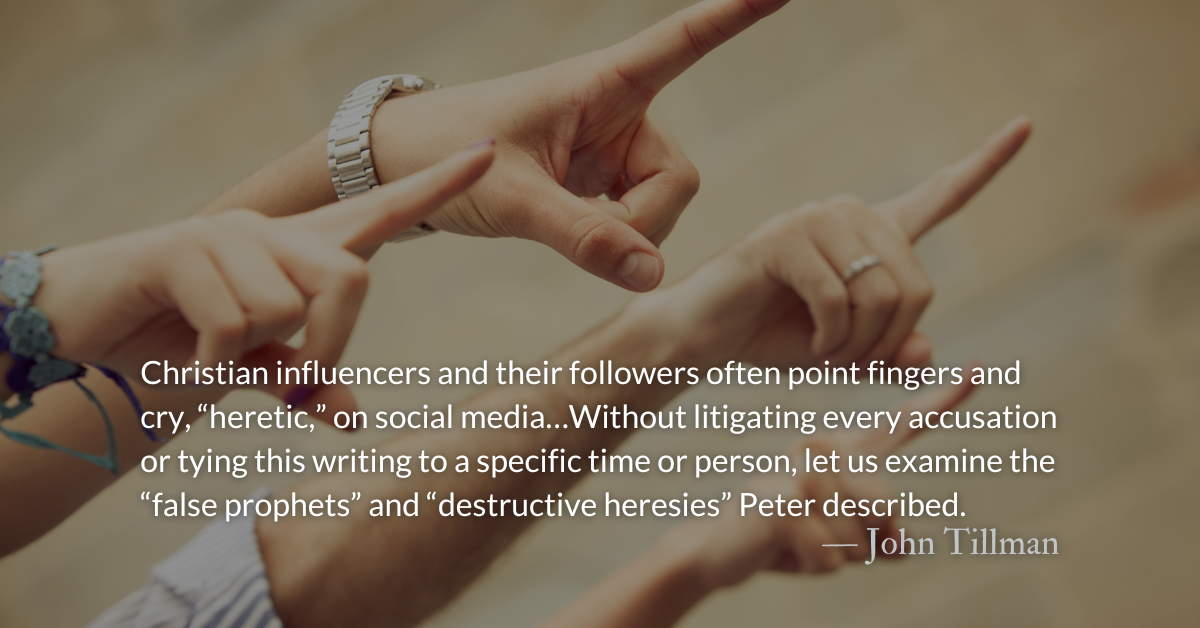
Christian influencers and their followers often point fingers and cry, “heretic,” on social media. (This is especially true of Christian influencers who spend more time talking about politics than scripture.) They’ll often quote Peter when they do this (2 Pet 2.1). But are they quoting Peter faithfully?
Without litigating every accusation or tying this writing to a specific time or person, let us examine the “false prophets” and “destructive heresies” Peter described.
First, heresies exist and proper teaching matters. Peter’s claim is historical. There were false prophets and teachings in Israel’s past and Peter’s present. This is true for us, also. We cannot dismiss “heresies” as something only relevant to the past or dismiss the need to address them.
Second, heresies are damaging. False teaching leads people to wrong belief and errant faith that will not save them. False teachers are “springs without water.” (2 Pet 2.17) False teaching is a placebo that won’t kill the cancer of sin and giving it out is not an act of love.
Third, false teachers deny Jesus as Lord. Peter doesn’t list exhaustive theological details of false prophets’ claims. His only theological identifier is denying “the sovereign Lord who bought them.” (2 Pet 2.1) False teachers will undermine or deny Jesus’ divinity, authority, or clear teaching.
Fourth, false prophets are also identifiable by their character. Peter spends more time warning about the character of false teachers than their doctrine. He lists greed, fabricated stories, adultery, lustful desires, debauchery, and depravity as characteristics that mark false teachers (2 Pet 2.3, 13-15, 18-19). Not all of these specific things are present in all cases. However, false prophets are driven by wealth-seeking, pleasure-seeking, and power-seeking.
Fifth, false prophets will be exposed and condemned. God’s justice means no one gets away with anything. Whatever successes, wealth, positions, or status false teachers attain will only add a greater weight of judgment, destruction, and wrath they will suffer (2 Pet 2.3, 13, 21-22).
We should take false teachings seriously because God does. However, the final judgment of these people is not up to us. We must also remember that those who are teaching something incorrectly are not necessarily “heretics” or “false prophets.” Motives matter. Apollos needed guidance and correction from Priscilla and Aquilla (Acts 18.24-27), not to be shouted at as a “heretic.”
Be humble and gentle in corrections with all people. Focus on caring for those who are being misled rather than on “taking down” a false prophet. And leave final judgment to God.
Divine Hours Prayer: A Reading
Jesus taught us, saying: “Be compassionate just as your Father is compassionate. Do not judge, and you will not be judged; do not condemn, and you will not be condemned; forgive, and you will be forgiven. Give, and there will be gifts for you: a full measure, pressed down, shaken together, and overflowing, will be poured into your lap; because the standard you use will be the standard used for you.” —Luke 6.36–38
– From The Divine Hours: Prayers for Autumn and Wintertime by Phyllis Tickle.
Read more: Sufferings and False Prophets
Peter, in his time, warned of false prophets by looking back in history. We can learn from this method as well.
Read more: Are We Soft About Suffering?
Have we suffered so little, for so long, that we think being argued with is “suffering” and minor inconveniences are “persecution”?

