What to Expect when Suffering :: A Guided Prayer

Psalm 116.11
…in my alarm I said,
“Everyone is a liar.”

Reflection: What to Expect when Suffering :: A Guided Prayer
By John Tillman

When in suffering, we can at times be surprised by the emotions that are stirred. We can encounter deep sadness, anguish, and even rage.

Suffering comes in many forms and many intensities. But our response follows a predictable pattern. Hope, impatience, despair, rage, doubt, rejection, redemption, and praise are all a part of the template of prayer that the psalmists show us. There is comfort in acknowledging the emotional rollercoaster that is the psalmists’ testimony.

Don’t be surprised or ashamed of the emotions that come in times of struggle and pain. With faith in God, we can move through cycles of emotions to the peace that God gives us in his presence.

Today we will follow a guided prayer with portions of Psalm 116 from today’s reading.

What to Expect When Suffering
“The cords of death entangled me,
the anguish of the grave came over me;
I was overcome by distress and sorrow.”


Oh God, in times of stress, despair, and struggle
We are overcome and need your comfort.

“I trusted in the Lord when I said,
‘I am greatly afflicted’”


But the world frustrates us, teaching us that any degree of suffering is waste.

“in my alarm I said,
‘Everyone is a liar.’”


You are the only trustworthy one, Lord,
But in our alarm, amidst fear and emotion
We sometimes call the wrong things lies

May we not reject community, simple kindness, praise, and loving words from those around us.
May we not reject being reminded that we are loved.

Instead we call the world a liar.
When they say a good life is pain-free
When they say pain proves God is not with us

“Precious in the sight of the Lord
is the death of his faithful servants.
Truly I am your servant, Lord;”


Rarely are our current sufferings deadly.
But, Oh God, even when they are…

You are with us now and in the hour of our death
We are precious to you at all times and in every outcome

And if the worst the world can imagine should happen to us
In our death, we simply enter your precious presence in “the courts of the house of the Lord.”

May we not wait until death to experience the peace of walking in your courts.
Help us to live, bringing the reality of your courts, on Earth as it is in Heaven.

Prayer: The Greeting
To you, O Lord, I lift up my soul; my God, I put my trust in you; let me not be humiliated, nor let my enemies triumph over me.
Let none who look to you be put to shame. — Psalm 25.1-2

– From The Divine Hours: Prayers for Summertime by Phyllis Tickle.

Today’s Readings
Deuteronomy 25 (Listen – 2:38) 
Psalm 116 (Listen – 1:34) 

Thank You!
Thank you to our donors who support our readers by making it possible to continue The Park Forum devotionals. This year, The Park Forum audiences opened 200,000 free, and ad-free, devotional content. Follow this link to join our donors with a one-time or a monthly gift. 

Read more about When Suffering Lingers :: Readers’ Choice
Early rabbinic writings understood the bush to be a symbol of ancient Israel—persevering under the flame of Egypt’s brutality. Though we burn, we are not consumed. This is the mere beginning of God’s grace.

Read more about The Crucible of Suffering
In the midst of suffering—when we don’t sense any positive change in our circumstances—we can start to question God’s goodness and his love.
Jesus with Axe and Fire

Psalm 115.3-4
Why do the nations say,
    “Where is their God?”
Our God is in heaven;
    he does whatever pleases him.
But their idols are silver and gold,
    made by human hands.

Reflection: Jesus with Axe and Fire
By John Tillman

Ancient idols of silver and gold seem so simple, pagan, and foolish. How could people have fallen for them? Today our idols are more likely to be rose-gold and come with an upgraded camera and a processor marginally faster than last years’.

Modern people are often guilty of shaking our heads at how quaint ancients must have been, worshiping their idols of stone, wood, and gold, not realizing how similar to them we are. We worship brands, companies, and CEOs with fervor equal to the most ardent of ancient adherents of Baal or Asherah. We give our money, adulation, and adoration to the brands that fit our aspirations and our ideals. We are, at times, more faithful to brands than to our churches or to our spouses. We wear their symbols on our clothing and follow their CEOs on Twitter, hanging on their every word.

We’d probably be better off worshiping actual idols of wood and stone than the brands that pander to us, telling us how smart we are to purchase their products. At least the wooden idols are truly dumb and unable to speak. The so-called wisdom we glean from CEOs often only leads us to invest further in consumerism rather than community. 

The problem with our idols is they are all internalized. Our external devices are merely manifestations of our self-love. We could throw away every piece of technology and still slavishly worship pride, consumerism, and comfort.

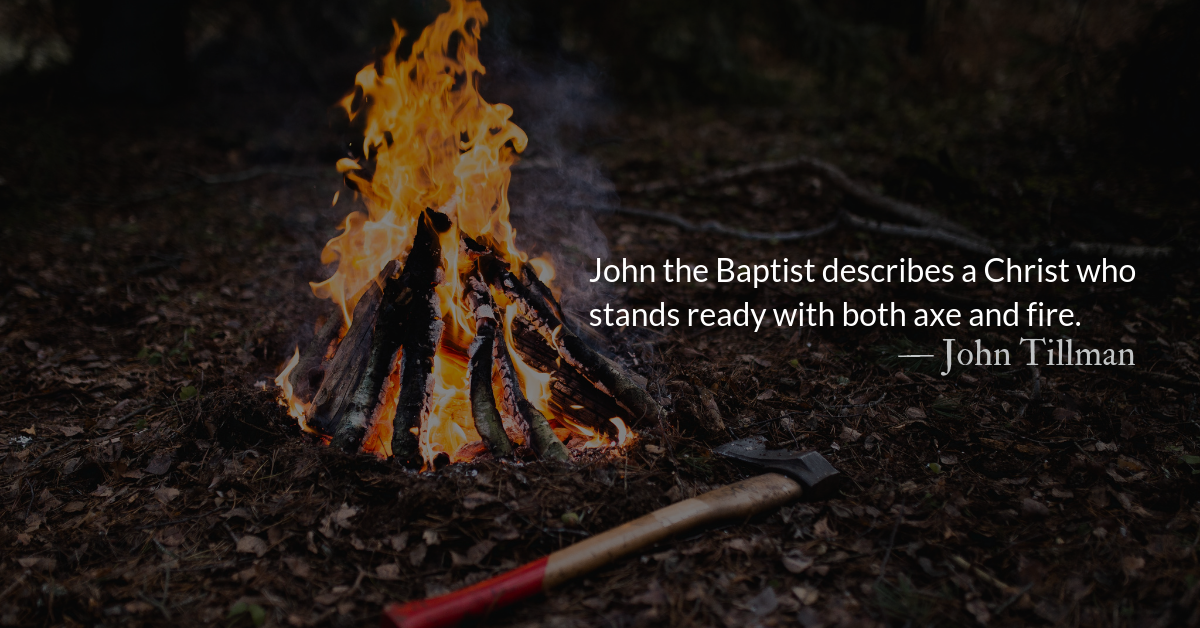
When Israel was commanded to cut down and burn Asherah poles there was a tangible, physical step. To burn out of our souls our preoccupation with ourselves we require a different kind of axe and a different kind of fire. Thankfully, Jesus stands ready to supply both. John the Baptist describes a Christ who stands ready with both axe and fire. 

May we ask him regularly to cut down our idols. May he burn out of our souls impurity and selfish desires. May he baptize us in fire, making of us a light for the world and a spark to ignite God’s love in our communities.

Prayer: A Reading
Jesus taught us, asking: “How can you believe, since you look to each other for glory and are not concerned with the glory that comes from the one God?” — John 5.44

– From The Divine Hours: Prayers for Summertime by Phyllis Tickle.

Today’s Readings
Deuteronomy 24 (Listen – 3:21) 
Psalm 114-115 (Listen – 2:18) 

Thank You!
Thank you to our donors who support our readers by making it possible to continue The Park Forum devotionals. This year, The Park Forum audiences opened 200,000 free, and ad-free, devotional content. Follow this link to join our donors with a one-time or a monthly gift. 

Read more about Lamenting Materialism
In ancient agrarian society if you worshiped a sun god or a fertility goddess or a god of weather or a god of bountiful harvest you were worshiping a god of financial success. It is akin to our worship of stock performance or financial forecasts or political economic policies.

Read more about In Denial about Greed and Power
If there is anything that can still be shocking in today’s world, it is that we still don’t fully admit or understand the destructive nature of the sins of greed and power.


He Stoops to Raise

Psalm 113.5-8
Who is like the Lord our God,
    the One who sits enthroned on high,
who stoops down to look
    on the heavens and the earth?

He raises the poor from the dust
    and lifts the needy from the ash heap;
he seats them with princes,
    with the princes of his people.

Reflection: He Stoops to Raise
By John Tillman

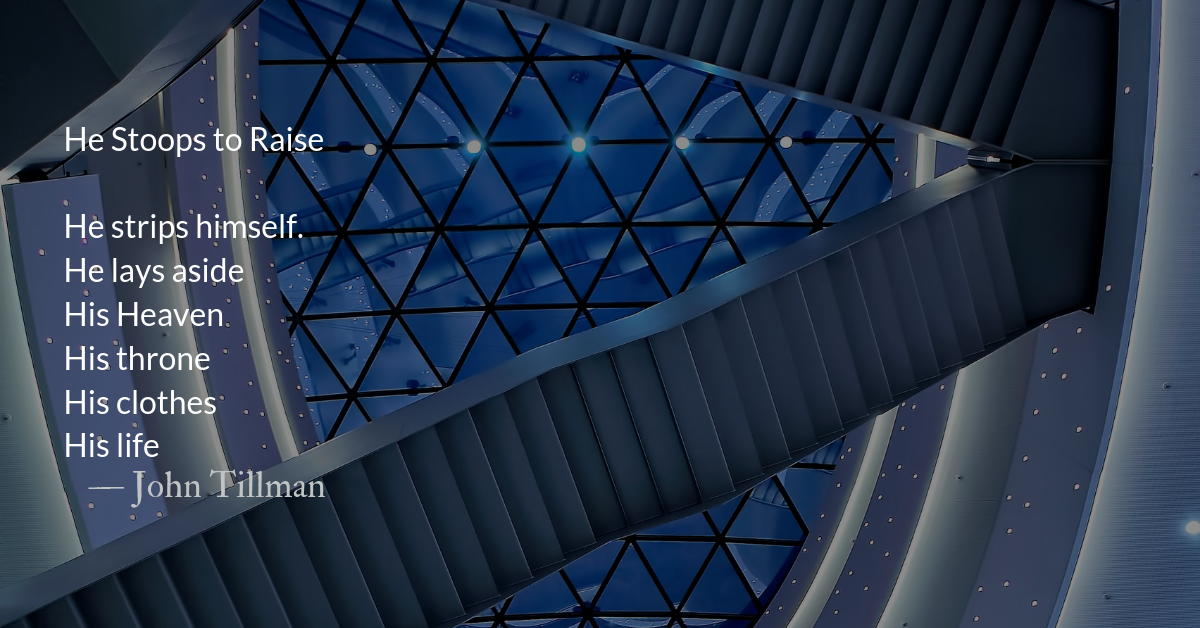
Christ’s entire life could be understood as a process of descending and ascending. From highest Heaven, to a manger. From honored teacher, to lowly footwasher. From worshiped Messiah and king, to cursed and crucified Lamb of God. He goes from the highest place, to the lowest place. And then, he ascends.

He Stoops to Raise
He strips himself.
He lays aside
His Heaven
His throne
His clothes
His life

He lowers himself
Steps down, descends
He stoops
He kneels
Head bowed
He bends

He sinks, He digs
He slides, Prostrates
Below
Our sin
Below
Hell’s gates

And then he lifts
His eyes, His face
Begins
To rise
To claim
His place

With him we rise
Gripped in His hand
The lost
The dead
No more
The damned

No more to die
Held by His side
Faithful
Redeemed
Raptured
We rise

Then he returns
All things in place
Restores
Rebuilds
Redeems
Remakes

He then ascends
His throne above
Worthy
The lamb
Our king
Our judge

Prayer: The Short Verse
“I am the Alpha and the Omega,” says the Lord God, who is, who was, and who is to come, the Almighty. — Revelation 1.8

– From The Divine Hours: Prayers for Summertime by Phyllis Tickle.

Today’s Readings
Deuteronomy 23 (Listen – 3:10) 
Psalm 112-113 (Listen – 1:49) 

Thank You!
Thank you to our donors who support our readers by making it possible to continue The Park Forum devotionals. This year, The Park Forum audiences opened 200,000 free, and ad-free, devotional content. Follow this link to join our donors with a one-time or a monthly gift. 

Read more about The Gospel is an Uprising
The Anastasis can be understood as “already and not yet.” It is both completed in the past, coming in the future, and happening now, in our midst.

Read more about A Better Resurrection :: Throwback Thursday
My life is like a frozen thing,
No bud nor greenness can I see:
Yet rise it shall—the sap of spring;
O Jesus, rise in me.

Restoration of Civility

Psalm 109.28
While they curse, may you bless;
may those who attack me be put to shame,
but may your servant rejoice.

Luke 6.45
A good man brings good things out of the good stored up in his heart, and an evil man brings evil things out of the evil stored up in his heart. For the mouth speaks what the heart is full of.

From John:
At The Park Forum, we have long wondered how powerful it would be if the Church took the lead in restoring public civility. We repeat this post from several years ago as a prayer that out of the overflow of our hearts our mouths would speak peace and love and hope that can only come from the Holy Spirit.

Reflection: Restoration of Civility
The Park Forum

“In Hebrew the term dabar means both word and deed,” Frederick Buechner observes. “Thus, to say something is to do something.” Buechner explains:

“Who knows what such words do, but whatever it is, it can never be undone. Something that lay hidden in the heart is irrevocably released through speech into time, is given substance and tossed like a stone into the pool of history, where the concentric rings lap out endless!”

How many ripples have we suffered in this year of political rancor? The collective loss of civility has been mourned as often as it has inflicted wounds across the spectrum. Yet, Hua Hsu writes for the New Yorker, “The problem with civility is the presumption that we were ever civil in the first place.” Hsu continues:

“Thanks to the Internet, we have become expert parsers of language, meaning, and authorial intent. We have grown obsessed with subtext. In other words, we live in very discursive times, when language seems to matter more than ever.”

“See how a great forest is set aflame by such a small fire! And the tongue is a fire,” warns the book of James. How powerful would it be if the Church were to lead in the restoration of public civility in American culture?

For such a restoration to take place we would have to begin with confession. For while the nearly-endless coverage of this year’s broken discourse makes it feel different, it is far from abnormal. In a piece promoting the upcoming Civility In The Public Square event, Timothy Keller explains:

“It could be argued that America has never really been a genuinely pluralistic, perspective-diverse, free society. We have never been a place where people who deeply differ, whose views offend and outrage one another, nonetheless treat each other with respect and hear each other out.”

Those who have held the reins of cultural power—its greatest academic centers, its most powerful corporations, the media—have often excluded unpopular voices and minority views that fell on the wrong side of the public morality of the day.

In the 1980s and ’90s, many white evangelical Christians wanted to occupy those places of power, and showed little concern at the time to create a society that respected communities with sharply differing moral visions.

Civility falters when people live in fear—fear that their views may be wrong; fear that their power is limited; fear that there is no sovereign who cares for their interests. But the rhythms of civility restore what was lost in the fall, as Buechner concludes:

“Words are power, essentially the power of creation. By my words I both discover and create who I am. By my words I elicit a word from you. Through our converse we create each other.”

Reading List
Civility In The Public Square. Timothy Keller for the Redeemer Report.
A Free People’s Suicide. Os Guinness for Q Ideas.
The Civility Wars. Hua Hsu for The New Yorker.
Uncommon Decency: Christian Civility in an Uncivil World. Dr. Richard Mouw.

Prayer: The Greeting
The Lord lives! Blessed is my Rock! Exalted is the God of my salvation! — Psalm 18:46

– From The Divine Hours: Prayers for Summertime by Phyllis Tickle.

Today’s Readings
Deuteronomy 22 (Listen – 4:13) 
Psalm 110-111 (Listen – 1:57) 

Thank You!
Thank you to our donors who support our readers by making it possible to continue The Park Forum devotionals. This year, The Park Forum audiences opened 200,000 free, and ad-free, devotional content. Follow this link to join our donors with a one-time or a monthly gift. 

Read more about Prayer, Silence, and Civility
How much we need our words to be incense today…how much we need the fragrance of our prayers to rise before God.

Read more about Killing With our Hearts
We rush to soften Christ’s teaching about violent thoughts and words because we are unwilling to let go of them.


Helping Fathers and the Fatherless

Psalm 109.9-12
May his children be fatherless
    and his wife a widow.
May his children be wandering beggars;
    may they be driven from their ruined homes.
May a creditor seize all he has;
    may strangers plunder the fruits of his labor.
May no one extend kindness to him
    or take pity on his fatherless children.

Reflection: Helping Fathers and the Fatherless
By John Tillman

People of David’s time understood that fatherlessness was a known cause of suffering for children and families. If children were fatherless, they were expected to be poor, wandering beggars. God’s people are commanded to be compassionate to widows and orphans precisely because God knew and cared for their hardship. 

What David may not have foreseen, however, is that today’s fatherless children would suffer not only the disinterest of society but the disinterest of their own fathers. Most of the fatherless children in David’s day knew that it was the horrors of war or exile or accident that had taken their fathers away unwillingly. Today’s fatherless often are left fatherless by choice not by catastrophe. They aren’t orphans of war, but of willful abandonment.

According to Vincent Dicaro at the National Fatherhood Initiative, fatherhood in the United States has made some gains in recent years, but not for everyone.

“While it is true that among middle-class families, father involvement is looking very good, it is also true that America has record levels of father absence, a crisis that mainly affects lower-income families. In fact, 24 million children, 1 out of every 3, lives in a home in which their biological father does not live. That rate is closer to 2 out of 3 in the African American community. And among those children living in father-absent homes, 1/3 have no contact with their dads, and another 1/3 have contact once per month or less.

So, the picture is actually quite bleak in too many communities across the country.” 


Fathers in our communities need the church’s help and support, not our judgment. The fatherless are in our communities not to suffer for the sins of their parents, but that we might have an opportunity to demonstrate the love of God, their true Father.

May we, along with introducing our communities to God the Father, introduce them to a definition and example of fatherhood that is based on the love that God has shown us.

May we work to ensure that the benefits of fatherhood and the resources needed to be a good father are spread to all levels of our communities.

May we lovingly bless the fatherless in our communities knowing that they are not there because of the sin of themselves or their parents, but that through them we might show the glory of God.

Prayer: The Call to Prayer
Come now and see the works of God, how wonderful he is in his doings toward all people. — Psalm 66.5

– From The Divine Hours: Prayers for Summertime by Phyllis Tickle.

Today’s Readings
Deuteronomy 19 (Listen – 3:04) 
Psalm 106 (Listen – 4:52) 

This Weekend’s Readings
Deuteronomy 20 (Listen – 2:55), Psalm 107 (Listen – 4:12) 
Deuteronomy 21 (Listen – 3:33), Psalm 108-109 (Listen – 4:28) 

Thank You!
Thank you for reading and a huge thank you to those who donate to our ministry, keeping The Park Forum ad-free and enabling us to continue to produce fresh content. Every year our donors help us produce over 100,000 words of free devotionals. Follow this link to support our readers.

Read more about Fatherhood’s Collapse, Love’s Destruction
Our view of love is anemic because our view of fatherhood is so damaged. It is God’s fatherhood that gives the depth, intimacy, and love we desire most

Read more about The Father of Fathers
You are the Father all fathers should be.
Gentle. Caring. Loving. Righteous. Just.