Responding to Political Violence

Scripture Focus: Psalm 52.1
1 Why do you boast of evil, you mighty hero? 
Why do you boast all day long, 
you who are a disgrace in the eyes of God? 

Ezekiel 13.10-12

10 “ ‘Because they lead my people astray, saying, “Peace,” when there is no peace, and because, when a flimsy wall is built, they cover it with whitewash, 11 therefore tell those who cover it with whitewash that it is going to fall. Rain will come in torrents, and I will send hailstones hurtling down, and violent winds will burst forth. 12 When the wall collapses, will people not ask you, “Where is the whitewash you covered it with?” 

Reflection: Responding to Political Violence

By John Tillman

Today’s scriptures show us David’s response to violent men like Doeg the Edomite in Psalm 52 and a faithless culture that denies God in Psalm 53.1-2 and they seem particularly relevant.

Political violence, like that committed by Doeg, was still the norm during Jesus’ ministry. The disciples were familiar with political murders and slaughters of innocents that would be shocking in today’s world. 

It is part of our modern vanity that we falsely believe ourselves beyond the violence of previous ages. Despite our sense of moral superiority, we have not advanced beyond violence for political ends.

Our political rancor has reached the point of normalizing violence. In the dystopian novel, 1984, Orwell described ”The Ministry of Peace” which dealt in war. The dystopian “War is Peace” concept has been gradually adopted by all political groups, Christians not excluded. 

It seems more and more Christians are willing to whitewash politically motivated violence as necessary self-defense. We have sunk to the point that political opponents (left and right) cheer their violent allies and point to violent opponents as justification for further violence. Such violent language unfailingly leads to murder in the streets. 

If trends continue, there will soon be an event similar to the Kent State shootings. For Christians to fail to condemn, or worse, to directly endorse this type of violence is a great moral and theological failing.

Ezekiel spoke to whitewashing prophets of his day who glossed over the weakness of “a wall” they claimed would defend the faithful from harm. Ezekiel told his listeners (and tells us) that everything they trusted in more than God would be destroyed and they would watch it fall in horror.

While psalmists and prophets often cheer the wielders of violence, Jesus sets a new standard for us when he calls us to bless and not curse, to turn the other cheek to insults, and to go the extra mile, enduring under oppression. 

We are called to stand up for and support those who are being oppressed to aid them, defend them, and speak out for them.

We are called to endure patiently our own oppression, ensuring that we are suffering for doing good, not for doing evil. 

May we remember that responding to oppression is not about vengeance or self-defense.

Our response must be one of remaining faithful in what we say and do, while patiently suffering the consequences of doing good.

Divine Hours Prayer: The Greeting

Lord, you have been our refuge from one generation to another.
Before the mountains were brought forth, or the land and the earth were born, from age to age you are God. — Psalm 90.1-2– Divine Hours prayers from The Divine Hours: Prayers for Summertime by Phyllis Tickle

Today’s Readings
Ezekiel 13  (Listen – 4:14)
Psalm 52-54 (Listen – 3:18)

Read more about Choosing Gentleness Over Violence
The language of many Christians and prominent Christian pastors has followed [the world], growing combative, disrespectful, and even violent.

Read more about Abandoning Human Vengeance
We must be the first to break the chain of retaliatory and violent rhetoric.
We must abandon human vengeance before we can see divine justice.

Have Mercy

Scripture Focus: Psalm 51.1
1 Have mercy on me, O God, 
according to your unfailing love; 
according to your great compassion 
blot out my transgressions.

Reflection: Have Mercy—Guided Prayer
By John Tillman

We think of sins as individual actions but that is only one dimension of sin.

David’s words, “against you, and you only, have I sinned,” do not mean that he did not sin against Bathsheba, or Uriah, or Joab, or against his whole nation. He sinned against God by bringing harm to those God cared for, who included Bathsheba, Uriah, Joab, and the entire nation.

David’s confession, often prayed by individuals to confess failings, acknowledges that David’s so-called individual sin brought harm upon more people than just himself. The healing brought by the confession will likewise be collective, not individual. David writes that his confession and God’s mercy will “prosper Zion” and “build up the walls of Jerusalem.” 

Pray this pluralized version of Psalm 51 this week, confessing not only our individual sins but the sins of our communities, churches, and nations.

Have Mercy
Have mercy on us, O God.
Yours is the only love unfailing
We pile up great, unending heaps of transgression
You pour out great, enduring floods of compassion

Have mercy on us, O God.
You are the only righteous judge.
Our sins fill the earth and reach the skies
Your justice rolls like rivers, comforting mothers’ sighs

Have mercy on us, O God
You alone bring new birth
We toil in darkness, faithless, broken, aimed toward death
You clothe us in light, resurrect faith, make us blessed

Have mercy on us, O God
You are our only holiness
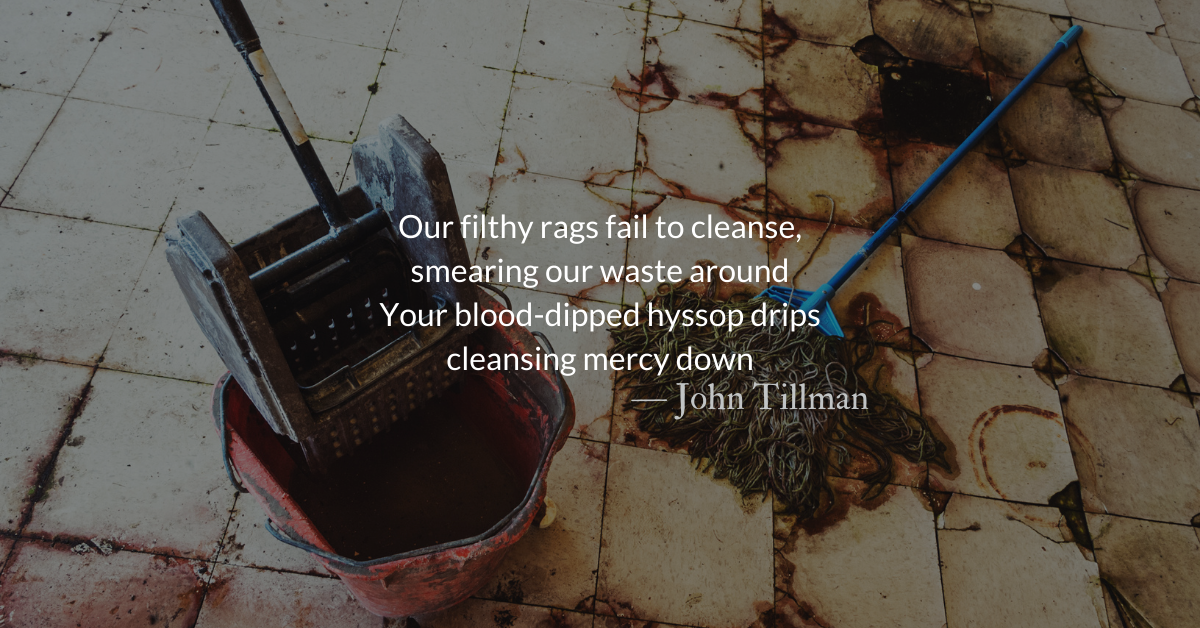
Our filthy rags fail to cleanse, smearing our waste around
Your blood-dipped hyssop drips cleansing mercy down

Have mercy on us, O God
Your purity stands alone.
Our ruin rots beautiful things. Our touch drips decay and doom
Where your fingers trace, truth, love, and beauty bloom

Have mercy on us, O God
Redeem our sin-wracked ways
Our errors and crimes, cause pain, hurt, and harm 
Your grace comes behind us, with love as your balm

Have mercy on us, O God
Make our lives a lesson
Our efforts are selfish, our success is hollow
Your mercy to us teaches sinners to follow

Divine Hours Prayer: The Small Verse
The people that walked in darkness have seen a great light; on those who live in a land of deep shadow a light has shone. — Isaiah 9.1– Divine Hours prayers from The Divine Hours: Prayers for Summertime by Phyllis Tickle

Today’s Readings
Ezekiel 12  (Listen – 4:26)
Psalm 51 (Listen – 2:19)

Read more about Rend Your Hearts
When we rend our heart in community with others, we invite God’s power to work in us for redemption and restoration.

Read more about The Radical Procedure of the Gospel
It’s lovely to think of God giving us a new hear…But it is terrifying to admit to the diagnoses that would lead to such a radical procedure.

A Hymn of the Oppressed—Throwback Thursday

Scripture Focus: Psalm 44.23-26
      23 Awake, Lord! Why do you sleep? 
         Rouse yourself! Do not reject us forever. 
      24 Why do you hide your face 
         and forget our misery and oppression? 

      25 We are brought down to the dust; 
         our bodies cling to the ground. 
      26 Rise up and help us; 
         rescue us because of your unfailing love. 

Reflection: A Hymn of the Oppressed—Throwback Thursday
By John Tillman

When the founding documents of the United States were written, the chief form of religious persecution with which the founding fathers were concerned was not an encroachment of Islam, or secularism, or Marxism. They had in front of mind religious persecution of Christians by Christians.

Despite his popularity as a hymnist, Isaac Watts was a nonconformist who suffered persecution by the Church of England. Like other nonconformists, he suffered exclusion from the best universities and from many employment opportunities, both secular and religious. Watts’s poetic rewrite of Psalm 44 reveals hints of the kinds of persecution he patiently endured.

Psalm 44, Isaac Watts.

Lord, we have heard thy works of old,
  Thy works of power and grace,
When to our ears our fathers told
  The wonders of their days.

How thou didst build thy churches here,
  And make thy gospel known;
Amongst them did thine arm appear,
  Thy light and glory shone.

In God they boasted all the day,
  And in a cheerful throng
Did thousands meet to praise and pray,
  And grace was all their song.

But now our souls are seized with shame,
  Confusion fills our face,
To hear the enemy blaspheme,
  And fools reproach thy grace.

Yet have we not forgot our God,
  Nor falsely dealt with heav’n,
Nor have our steps declined the road
  Of duty thou hast giv’n;

Though dragons all around us roar
  With their destructive breath,
And thine own hand has bruised us sore
  Hard by the gates of death.

     PAUSE.

We are exposed all day to die
  As martyrs for thy cause,
As sheep for slaughter bound we lie
  By sharp and bloody laws.

Awake, arise, Almighty Lord,
  Why sleeps thy wonted grace?
Why should we look like men abhorred
  Or banished from thy face?

Wilt thou for ever cast us off,
  And still neglect our cries?
For ever hide thine heav’nly love
  From our afflicted eyes?

Down to the dust our soul is bowed,
  And dies upon the ground;
Rise for our help, rebuke the proud,
  And all their powers confound.

Redeem us from perpetual shame,
  Our Savior and our God;
We plead the honors of thy name,
  The merits of thy blood.


When we read of persecution, either in the scriptures or in history, we tend to think we ought to learn to be like the heroic victims. This is a worthy goal. However, history might be very different if rather than idolizing the martyrs, we could study how not to become the oppressors.

*Poem from The Psalms of David Imitated in the Language of the New Testament:

Divine Hours Prayer: The Greeting
My mouth shall recount your mighty acts and saving deeds ll day long; though I cannot know the number of them. — Psalm 71.5– Divine Hours prayers from The Divine Hours: Prayers for Summertime by Phyllis Tickle

Today’s Readings
Ezekiel 6  (Listen – 2:49)
Psalm 44 (Listen – 2:44)

Read more about What Is Persecution?
It is a sign of great uncharitableness and cruelty, when men can find in their hearts to persecute others for little things — Richard Baxter

Read more about Complete Our Joy — Guided Prayer
Joy permeated the church despite the pervasiveness of persecution and the pressures of the surrounding culture.

A Discipline for the Anxious :: Readers’ Choice

Selected by reader, Melissa from Texas
Praying in this way has helped me. I really appreciate the comparison of meditation to inoculation rather than an antidote. 

Scripture Focus: Psalm 77.2-3
When I was in distress, I sought the Lord;
at night I stretched out untiring hands,
and I would not be comforted.
I remembered you, God, and I groaned;
I meditated, and my spirit grew faint.

Reflection: A Discipline for the Anxious :: Readers’ Choice
Originally published September 25th, 2018
By John Tillman

We live in distressing times. If there are corners of our world not touched by division, aggression, worry, and angst, you probably can’t get email there.

Anxiety, depression, and other mental health issues are on the rise—especially among younger adults. National Survey of Children’s Health researchers found a 20 percent increase in diagnoses of anxiety among children ages 6 to 17, between 2007 and 2012. The American College Health Association found that anxiety, rather than depression, is the most common reason college students seek counseling services and that in 2016, 62 percent of undergraduates reported “overwhelming anxiety” in the previous year. (An increase from 50 percent in 2011.)

Studying this, science is discovering things that are not exactly new under the sun. A recent Harvard study found that church attendance paired with spiritual disciplines such as meditation and prayer have a beneficial effect on mental health. In a Forbes article, study author Ying Chen noted that being raised religiously, “can powerfully affect [children’s] health behaviors, mental health, and overall happiness and well-being.”

The psalmists would not express surprise at these findings. Though we think of our society as facing pressures unknown to humanity until now, we would be mistaken to think of ancient times as idyllic and calm.

David and the other psalmists certainly knew what it was like to live under threat, under financial pressure, under the constant weight of political instability and the wavering loyalty of an unpredictable government.

Amidst such pressures, they had a safe haven. Their help for the stresses of life was meditation and prayer.*

The psalmist writes of being “too troubled to speak,” yet he cries to God. He writes of insomnia, yet he rests in God. He writes of doubts and of feeling that God has rejected him, that his love has vanished, that he had forgotten to be merciful. Yet in the midst of doubts and fears, he remembers God’s faithfulness in the past. He meditates on these memories in the heated moment of stress.

Although the benefits of meditation can help in a crisis, meditation is not a quick fix. It is not a fast-acting antidote for the world’s venom, but an inoculation to be taken ahead of time.
When beginning (or returning to) meditative prayer, start small and short. Use the prayer provided at the end of this devotional (Psalm 119.147) as a start. Spend two to five minutes simply re-reading the prayer with an expectant heart, asking God to be with you.

*We are in no way implying that meditation should be pursued in lieu of proper medical treatment. If you are in need of counseling and professional services, please consider the following resources:

Mental Health Grace Alliance
Not A Day Promised Resource Page
Life Recovered (Resources for Ministers)
Suicide Prevention Lifeline
Action Alliance for Suicide Prevention
Suicide Prevention Resource Center

Divine Hours Prayer: The Request for Presence
Gladden the soul of your servant, for to you, O Lord, I lift up my soul. — Psalm 86.4

– From The Divine Hours: Prayers for Summertime by Phyllis Tickle.

Today’s Readings
1 Samuel 20 (Listen – 6:42) 
1 Corinthians 2 (Listen – 2:26)

Thank You!
Thank you to our donors who support our readers by making it possible to continue The Park Forum devotionals. This year, The Park Forum audiences opened 200,000 free, and ad-free, devotional content. Follow this link to join our donors with a one-time or a monthly gift.

Read more about The Practice of Meditation :: Running
One way of thinking of meditative prayer is exercise to expand your spiritual lung capacity, allowing you to breathe in God’s spirit more naturally at any time—including during a crisis.

Read more about The Practice of Meditation :: Tea
Allow the scripture to soak in your mind, repetitively dip it in your thoughts as you would a tea bag into warm water. 

God Shivering on Concrete :: Readers’ Choice

Selected by reader, Pastor Terri Phillips, from Fort Worth, Texas.
My daily routine these days includes moments, or even hours, of inner rage about injustice. Most of the time, I am limited in my verbal response, and often my hands feel tied in responding in action. This post reminded me to look for evidence of God’s love, even in the most wretched of circumstances and events.  And to remind myself that the loving justice of God is sure. I may not be an instrument to render justice, as I fantasize to do, but I can more than imagine ways to deliver the fruit of the Spirit to the “least” of those around me. I don’t have to wait for a politicized, public moment to express love, kindness, joy, patience, and goodness. I can purpose to do that every time I see a need. I can share the Gospel, AND I can give a cup of cold water, give my finances, and shield the helpless.  When I am with Jesus on the Concrete, I am empowered by the Holy Spirit of God.

Scripture Focus: Psalm 119.50-53, 61, 64
My comfort in my suffering is this:
   Your promise preserves my life.
The arrogant mock me unmercifully,
   but I do not turn from your law.
I remember, Lord, your ancient laws,
   and I find comfort in them.
Indignation grips me because of the wicked,
   who have forsaken your law…
Though the wicked bind me with ropes,
   I will not forget your law…
The earth is filled with your love, Lord;
   teach me your decrees.

Only the suffering God can help. — Dietrich Bonhoeffer

Reflection: God Shivering on Concrete :: Readers’ Choice
Originally published June 24th, 2019
By John Tillman

There is great wickedness in the world. Yet, in such a world, the psalmist proclaims God’s love, the power of God’s laws, and the strength of his desire to know his God more deeply.
Even in a world in which a person may be bound with ropes, or separated from their family, or denied justice, or put into a cage, or killed for the convenience of others, or hung from a tree, or gunned down in a church… Even in such a world, the psalmist tells us, “God’s love is evident.”

Wickedness is evident. But God’s love is also evident.

It is evident in the many Christian and secular organizations that move, at times into dangerous circumstances, to help the downtrodden, the poor, and those purposely excluded from justice. It is evident in the disaster that our God promises to bring upon a nation that ignores its responsibilities to the poor and to the foreigner. Our God humbles nations addicted to greed—including His own. Our God sends help to the helpless, no matter the owner of the goods, the ship, the truck, or the organization.

God’s love is evident in God’s help, but more so in his presence. Our God is with those who suffer. Our God lies on concrete floors under aluminum blankets with abandoned children. He bleeds on the floor of a sanctuary with victimized worshipers. His arms bear wounds of unjust captivity. He bears scars familiar to those who have been brutalized by government forces.

God’s love is, of course, most fully evident in what we call the gospel. The gospel puts wickedness to death in the way it deserves. Christ, through the cross, drags evil to Hell and abandons it there, setting free Hell’s captives. But merely chuffing about “the gospel” in the face of evil makes us into signposts on the road to Hell rather than gatekeepers in the house of our God.

One of the endlessly repeating themes of scripture and especially the Old Testament is that God’s people are to be kind and compassionate to foreigners and strangers.

Reach out in God’s love in any way that is available to you, whether through financial means or political. Even giving a cup of water in the name of Christ to the least of these will be remembered.

Divine Hours Prayer: The Refrain for the Morning Lessons
Blessed be the Lord! For he has shown me the wonders of his love in a besieged city. — Psalm 31.21

– From The Divine Hours: Prayers for Summertime by Phyllis Tickle.

Today’s Readings
1 Samuel 18 (Listen – 4:30) 
Romans 16 (Listen – 3:30)

Thank You!
Thank you to our donors who support our readers by making it possible to continue The Park Forum devotionals. This year, The Park Forum audiences opened 200,000 free, and ad-free, devotional content. Follow this link to join our donors with a one-time or a monthly gift.

Read more about In Denial about Injustice
To judge our cities (to lead them) we cannot be in denial about injustice. Denying the existence of injustice is not how to be a patriot. It is how to get exiled.

Read more about Truth Unwanted :: A Guided Prayer
Remind us, Lord, that this world is not our home to defend, but it is the world you died for and we can expect to do no differently.