
Responding in Kind

Scripture Focus: Psalm 76.5-12
5 The valiant lie plundered, 
they sleep their last sleep; 
not one of the warriors 
can lift his hands. 
6 At your rebuke, God of Jacob, 
both horse and chariot lie still. 
7 It is you alone who are to be feared. 
Who can stand before you when you are angry? 
8 From heaven you pronounced judgment, 
and the land feared and was quiet— 
9 when you, God, rose up to judge, 
to save all the afflicted of the land. 
10 Surely your wrath against mankind brings you praise, 
and the survivors of your wrath are restrained. 
11 Make vows to the Lord your God and fulfill them; 
let all the neighboring lands 
bring gifts to the One to be feared. 
12 He breaks the spirit of rulers; 
he is feared by the kings of the earth. 

2 Kings 19.16
…listen to all the words Sennacherib has sent to ridicule the living God.”

Isaiah 37.22
22 this is the word the Lord has spoken against him:
“Virgin Daughter Zion
    despises and mocks you.
Daughter Jerusalem
    tosses her head as you flee.

Reflection: Responding in Kind
By John Tillman

Our recent reading from 2 Kings 19 included the story of Sennachrib’s threats against Jerusalem and his defeat without Judah even lifting a sword. The story repeats in Isaiah 37, and many Psalms, such as Psalm 76, 46, and 59, reflect on it.

Sennacherib claimed other gods had not saved their lands from him, and Judah’s God would fare no differently. Hezekiah physically brought the letter to the Temple, laid it out before the Lord, and read out Sennacherib’s words. “…listen to all the words Sennacherib has sent to ridicule the living God.” (2 Kings 19.16)

Isaiah brought Hezekiah a response to Sennacherib. Isaiah’s poem (Isaiah 37.22-35) is a scoffing prophecy. It returns Sennacherib’s scorn, spite for spite. Isaiah tells the man who thinks himself a god-killer that God will lead him by a hook through his nose.

Like Isaiah, Hezekiah, and the psalmists, we live in a world that is in love with scorn. Simply by living and believing the words of Jesus, we are targets of derision, mockery, and outrage. For trusting in the Bible, we experience attacks, accusations, and even violence.

There are powerful cultural and political forces in this world that treat our God as Sennacherib did. Powerless. Irrelevant. Laughable. Often, we want to strike back with our own scornful takedowns, bluster, and insults.

There’s an old saying that we don’t have to attend every fight we are invited to. While scoffers and scorners sharpen their arrows, let us turn to God and keep our vows to him. God doesn’t need our defense but he does desire our devotion.

Do we have insecurities or bitterness triggered by insults, harm, or attacks? Are there counter-attacks forming in our minds? Insults bubbling in our hearts?

Instead of responding in kind, let us turn their words over to God as Hezekiah did. Lay out their words and actions before the Lord. Read him the tweet. Forward him the email. Show him what was done or said.

There is a time to speak facts and engage in healthy debate. There is a time for sarcasm and biting wit. There is a time to stand as God does, holding out our arms all day long to obstinate people. (Isaiah 65.1-3) There is also a time to close our mouths, let people be wrong, and pray that in his mercy, God will break through where we fail.


Divine Hours Prayer: The Refrain for the Morning Lessons
No good things will the Lord withhold from those who walk with integrity. — Psalm 84.11

– From The Divine Hours: Prayers for Summertime by Phyllis Tickle.

Today’s Readings
2 Kings 22 (Listen 3:45
Psalms 75-76 (Listen 2:33)

Read more about Wisdom & Persuasion
Sennacherib and the Assyrians taunted the Israelites…stoking the people’s fear…fear was a potent tactic.

Read The Bible With Us
Ask friends to join you in our Bible reading plan. Grow together at a sustainable, two-year pace.
https://mailchi.mp/theparkforum/m-f-daily-email-devotional

Edge of the Abyss

Scripture Focus: Psalm 74:9
9 We are given no signs from God;
     no prophets are left,
     and none of us knows how long this will be.

Reflection: Edge of the Abyss
By Erin Newton

Laments are uttered when we come to the end of ourselves. The strong have no need for laments.

We watch as the psalmist lays before God the wretched state of emotions. The sanctuary is ruthlessly destroyed with wave after wave of terror. There is no hope of relief. The psalmist stands and stares into the darkness. Federico Villanueva aptly describes the collective emotion behind Psalm 74, describing the people as “those who are ‘balancing on the edge’ of such an abyss.”

The abyss of despair is like the watery depths of the ocean. It can be a pool of murky water concealed in a dark cave. The feeling is solitary and overwhelming. It can sometimes be the turbulent whirlpools sending all creatures crashing to the ocean floor. The feeling is crushing—helpless, hopeless, vulnerable.

Not many of us will watch someone physically destroy church buildings or burn places of worship. But the psalmist says, “the place where you met with us.” Humanity once walked among the trees with God in Eden. Now, we meet with God in our prayers, in our meditation, in our worship, in our study, and in our fellowship.

Axmen still come and wield their sharpened tools. Someone can come along and destroy these holy meeting places with lies and deception. Organizations can fell the trees of our faith with silence and threats.

When it seems like hope is lost, each breath becomes the song of the lament. Where are you, God? Why are you not here? How long will this last?

The same images of despair become the beacon of hope. The darkness, the waters, the cold, the monsters— these become the message of promise. What God has done in the past gives hope for what he will do in the future.

God harnessed the expanse of the universe, setting boundaries for the sun and the moon. The seasons were set in motion bringing spring to follow winter. Leviathan, chaos incarnate, was crushed and tossed as food to wild animals.

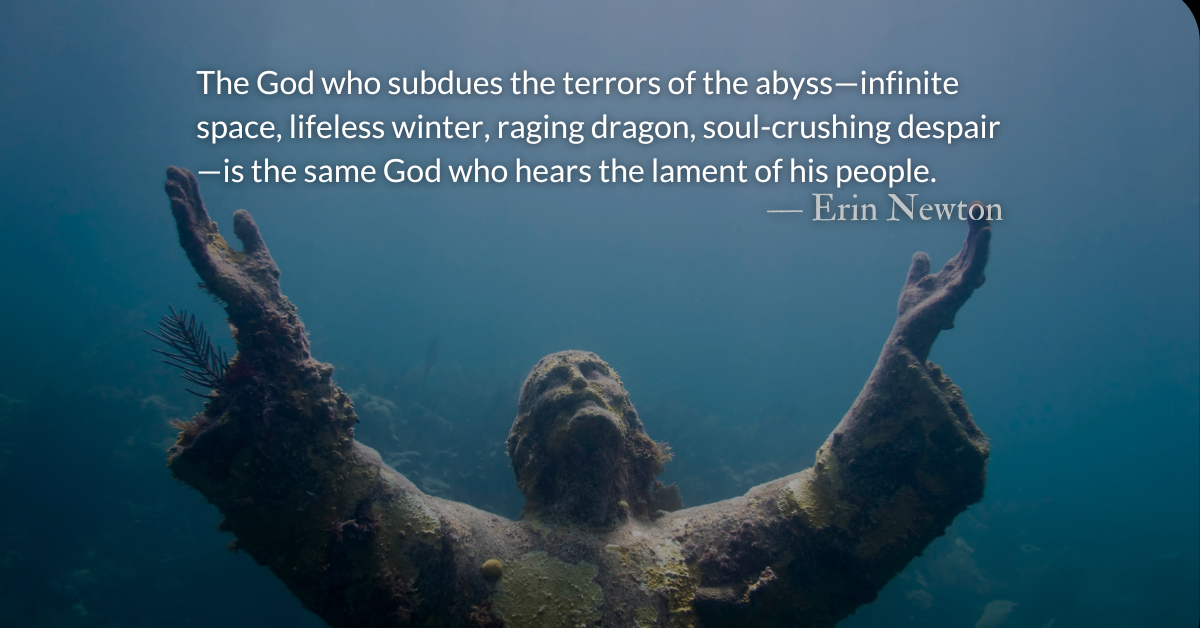
The God who subdues the terrors of the abyss—infinite space, lifeless winter, raging dragon, soul-crushing despair—is the same God who hears the lament of his people.

Let us call upon the God who closes the mouth of the abyss and ask him to remember the vulnerable and the abused. May no person take an ax to the place where God meets with his creation.


Divine Hours Prayer: The Refrain for the Morning Lessons
Send forth your strength, O God; establish, O God, what you have wrought for us. — Psalm 68.28


– From The Divine Hours: Prayers for Summertime by Phyllis Tickle.


Today’s Readings
2 Kings 21 (Listen 4:06
Psalms 74 (Listen 2:34)

Read more about The Struggle against Chaos
One of the thoughts we struggle with is the idea that all the events of life are haphazardly occurring, without meaning, spinning out of control.

Read more about Anxious Nights Between Destruction and Chaos
From the chaos of the sea and the wilderness wind, God brings order and a highway to salvation.

We, Your People

Scripture Focus: Psalm 72.12-14
12 For he will deliver the needy who cry out,
the afflicted who have no one to help.
13 He will take pity on the weak and the needy
and save the needy from death.
14 He will rescue them from oppression and violence,
for precious is their blood in his sight. 

Reflection: We, Your People
By John Tillman

The true king that the psalmist references is not Solomon or any political realm to follow. Jesus is the true king who liberates and brings justice.

The golden age Solomon ushered in rode on the back of immense taxes and slave labor. Solomon’s political alliances were sealed with unholy marriages and consecrated by temples built to idols. What looked like paradise was paid for by hellish means.

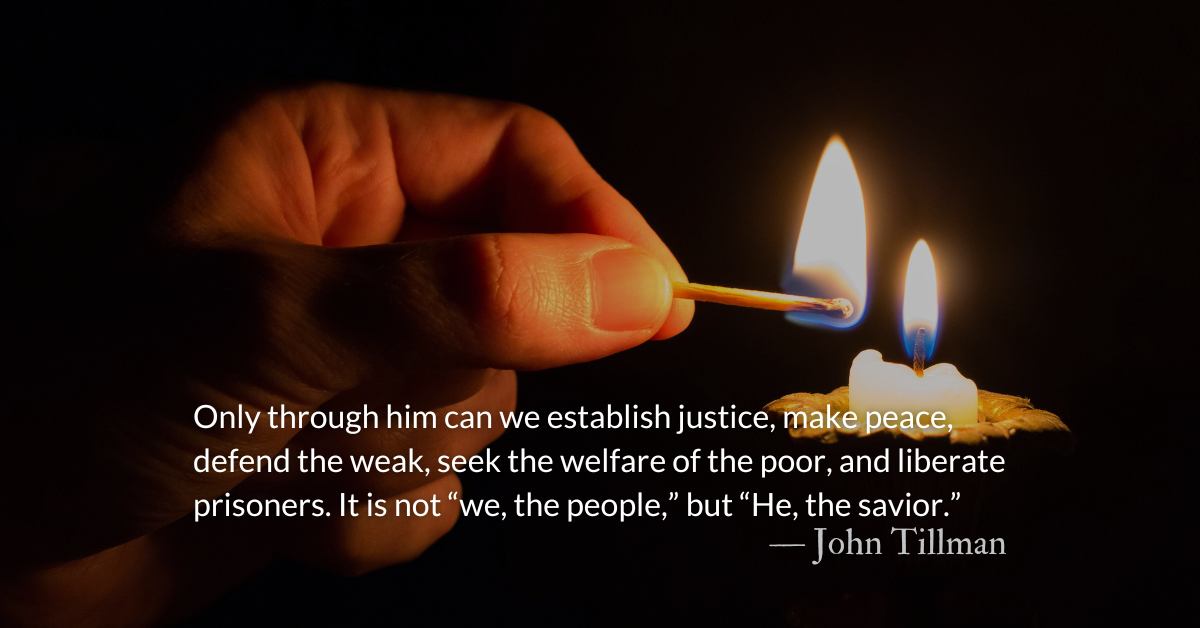
Jesus, by contrast, took the weight of hell on his back and set us free from its burden. Now, Jesus calls us to be part of the glorious kingdom he’s building. The true son makes us true heirs. Only through him can we establish justice, make peace, defend the weak, seek the welfare of the poor, and liberate prisoners. It is not “we, the people,” but “He, the savior.”

Let this prayer, based on Psalm 72, constitute a confession and request that Christ will make us true heirs and ambassadors of his righteousness.

Prayer of We, Your People
We, your people, Lord, acknowledge that justice deserving the name does not come from us. Our best work will be partial and incomplete…

Endow us with your justice, O God… (v 1)
Help us defend the afflicted, save the children of the needy, and crush oppression in all its forms. (v 4)

We claim your promise to us through Eve that her seed would crush evil. (Genesis 3:15)
We give our lives and bodies as Mary did. Use us to bring down wicked rulers, lift the humble, and fill the needs of the hungry. (Luke 1.52-53)

We confess we have been deaf. Give us ears to hear the needy.
We confess we have been cowardly. Give us strength to help the afflicted.
We confess we have been hard-hearted. Give us compassion for the weak and empathy with those under oppression and violence, for precious is their blood in your sight. (v 12-14)

May we work in the name of Christ our King. Anoint us with your Spirit to proclaim good news to the poor, to bind up the brokenhearted, to proclaim freedom for the captives, and to release prisoners from darkness. (Isaiah 61.1-2)

Where earthly governments join these tasks, may we walk with them. But never let us rely on earthly kings to carry out the tasks of the heavenly kingdom.

Praise be to his glorious name forever;
may the whole earth be filled with his glory.
Amen and Amen. (v 19)

Divine Hours Prayer: The Refrain for the Morning Lessons
“Because the needy are oppressed, and the poor cry out in misery, I will rise up,” says the Lord, “ And give them the help they long for.” — Psalm 12.5

– From The Divine Hours: Prayers for Summertime by Phyllis Tickle.

Today’s Readings
2 Kings 19 (Listen 6:11
Psalms 72 (Listen 2:21)

Read more about Calling the Kettle
David knew better than most that human leaders, especially himself, were incapable of bringing the kind of justice he wrote of.

Read more about Supporting Our Work
Please consider becoming a donor. Support ad-free content that brings biblical devotionals to inboxes across the world.

In Great Company

Scripture Focus: Psalm 68.11
11 The Lord announces the word,
    and the women who proclaim it are a mighty throng:

Reflection: In Great Company
By John Tillman

For a decade of ministry, I quoted this verse from the NKJV: “…Great was the company of those who proclaimed it.” (Psalm 68.11) Our traveling ministry group was called “The Company.” When we introduced ourselves, we leaned into the pun but emphasized that “great” did not refer to the quality of our group but to the great number of God’s people charged to proclaim the good news.

Some commentators describe Psalm 68 as a liturgical script for a procession. It may have been a song to accompany a reenactment of the Ark of the Covenant arriving at the Temple. As an artist and actor, this possibility is intriguing. It does seem that parts of the psalm reenact the past, and parts predict the future.

In context, the “word” proclaimed in this psalm is good news of a battle won. Powerful and wicked kings and armies are overthrown as if they are nothing. The psalmist compares them to smoke scattered with a breath or wax melting away before the flames even touch it.

It is news of a victor who is mighty to save. The vulnerable are protected. The lonely are gathered into families. The prisoners are liberated. The poor are bountifully supplied.

This word of good news is true in several ways. It is historically and literally true. God gave Israel many military victories. It is prophetically and metaphysically true. God promises to crush the serpent’s head and destroy evil throughout all time and creation.

Most of all, it is finally, physically and spiritually true in Jesus. He shed his blood for us, his enemies, and was crushed for our misdeeds. Yet, he is the victor who wins the battle. He has overthrown sin and death as if they were nothing. He is the liberator who breaks captives’ chains. He is the provider who bountifully gives to the poor.

We don’t do many celebratory liturgical reenactments in the modern church. One that we do often, however, is communion. When partaking of the cup and the bread, you are also proclaiming its message. Communion proclaims Jesus’ death, his victory, his gifts, and his glory. 

We are part of a great company charged with proclaiming the good news. Let our reenactment spill out of the sanctuary. May we reenact and proclaim the life of Jesus, not merely in art or liturgy but in action and love.

Divine Hours Prayer: The Call to Prayer
Bless our God, you peoples; make the voice of his praise to be heard;
Who holds our souls in life, and will not allow our feet to slip. — Psalm 66.7-8

– From The Divine Hours: Prayers for Summertime by Phyllis Tickle.

Today’s Readings
2 Kings 16 (Listen 3:46)
Psalms 68 (Listen 4:26)

This Weekend’s Readings
2 Kings 17 (Listen 7:19Psalms 69 (Listen 4:04)
2 Kings 18 (Listen 6:72Psalms 70-71 (Listen 3:29)

Read more about The Facade of Worship
What platforms are we willing to sacrifice for that compete with the sole worship of God? Some things must be secondary in life; God must be primary.

Read more about Platforming Idols
Sometimes, not always, the burden in our lives is the false god we’ve decided to carry…

The Blooming Desert

Scripture Focus: Psalm 63
1 You, God, are my God, 
earnestly I seek you; 
I thirst for you, 
my whole being longs for you, 
in a dry and parched land 
where there is no water. 
2 I have seen you in the sanctuary 
and beheld your power and your glory. 
3 Because your love is better than life, 
my lips will glorify you. 
4 I will praise you as long as I live, 
and in your name I will lift up my hands. 
5 I will be fully satisfied as with the richest of foods; 
with singing lips my mouth will praise you. 
6 On my bed I remember you; 
I think of you through the watches of the night. 
7 Because you are my help, 
I sing in the shadow of your wings. 
8 I cling to you; 
your right hand upholds me. 
9 Those who want to kill me will be destroyed; 
they will go down to the depths of the earth. 
10 They will be given over to the sword 
and become food for jackals. 
11 But the king will rejoice in God; 
all who swear by God will glory in him, 
while the mouths of liars will be silenced.

Reflection: The Blooming Desert
By John Tillman

Cartoons I watched on lazy Saturdays had a familiar visual gag to depict hunger. Two companions would be stranded without food on a deserted island. Maddened by hunger, one would watch the other slowly turn into a delicious-looking ham or a turkey leg. Meanwhile, the other would watch their companion turn into a bucket of fried chicken. Soon they would chase each other around the island, but they were chasing an illusion.

David’s desert Psalm mentions things one might fantasize about in the desert or on a deserted island. He speaks of the richest of foods and of his thirst being quenched. David’s spiritual analogy may have been inspired by physical reality.

Spiritually, we live in a desert where there is no water. We walk in a land where no food grows.

Everything our culture says to drink causes thirst rather than quenches it. Everything our culture says to consume poisons health rather than promotes it. Our world is a spiritual food desert where the only food available is not true food at all. The impulses and instincts they call life-giving make us starved and shriveled devils.

“The most dangerous thing you can do is to take any one impulse of your own nature and set it up as the thing you ought to follow at all costs. There is not one of them which will not make us into devils if we set it up as an absolute guide. You might think love of humanity in general was safe, but it is not. If you leave out justice you will find yourself breaking agreements and faking evidence in trials “for the sake of humanity,” and become in the end a cruel and treacherous man.” — CS Lewis, Mere Christianity

Satisfying instinct leaves us unsatisfied. Filling physical desire leaves us unfulfilled. Like the cartoon companions, we chase seemingly satisfying illusions. Not only are they not real, but if we ever catch them, we’d reap only sorrow and guilt.

David found life that really matters is not fed by natural things. God is better than food, better than drink, better than sleep. He is the bread and water of life. He is our peace and our rest.

Jesus is a fountain springing up in the desert that enlivens the driest, most hopeless ground. When we drink deeply of living water, we can make the desert bloom.

Divine Hours Prayer: The Small Verse
The Lord is my shepherd, and nothing is wanting to me. In green pastures, He has settled me.


– From The Divine Hours: Prayers for Summertime by Phyllis Tickle.

Today’s Readings
2 Kings 13 (Listen 4:33)
Psalms 62-63 (Listen 2:42)

Read more about Quotations from the Desert
Christ and the Israelites weren’t hungry in the desert for no reason. Nor are we.

Read more about Ready to Exit the Desert
May we leave sin and doubt in the desert, crossing the Jordan toward God’s calling to be his city on a hill.