Holidays and Death’s Silence

Scripture Focus: Psalm 94:17
17 Unless the Lord had given me help,
    I would soon have dwelt in the silence of death.

Reflection: Holidays and Death’s Silence
By Erin Newton

“What is there really to be thankful for this year?” I sat outside with my dad talking about the upcoming holidays. This is our first major holiday without my mom and there is the painful silence of her absence.

Holidays have all the promises of cheer and merriment as well as the oppressive weight of forced happiness and performative joy. Another friend lamented, “I feel rushed and unable to enjoy the season.” We all feel some sort of pressure from outside circumstances or inward expectations.

Psalm 94 would not be a text you would choose for Thanksgiving and the beginning of Advent. It is a plea for God to enact justice against the wicked. The cry is to God as judge and avenger. But the psalmist’s foot is slipping. Life has become perilous. Anxiety sets in.

In many ways Psalm 94 is a perfect choice for this season. International wars rage around us. Family battles seem no less destructive. Undeserved suffering continues to plague our everyday life.

The Psalmist says, “Unless the Lord had given me help…” The recognition of crises, trauma, grief, pain, hopelessness, and our weakness to remedy it is important. In the same way I have been asked how I manage continuing school or writing or hosting Bible studies in the midst of the never-ending grief. My heart responds, “If it had not been for…,” and I continue with some truth that has anchored me in this turbulent time.

If it had not been for the truth of heaven, I would have dwelt in the silence of death.

If it had not been for the psalms of lament, I would have dwelt in the silence of death.

If it had not been for the hand of Jesus ministering through the hands of a friend who sits quietly next to me as I cry, I would have dwelt in the silence of death.

There are the anchors of faith to buoy us up from the depths of darkness. We remain in the waters, tossing and drifting at sea. But we remain afloat, perhaps just in survival mode as the waves of a busy, social-event-filled month crash over us.

Let us take a moment to consider how God supports us by his unfailing love (v. 18) and gives us joy through his consolation (v. 19). Meditate on how you would finish the phrase, “If it had not been for…”  

Divine Hours Prayer: The Call to Prayer
Search for the Lord and his strength; continually seek his face. — Psalm 105.4

– From The Divine Hours: Prayers for Summertime by Phyllis Tickle.

Today’s Readings
1 Chronicles 19-20 (Listen 5:02)
Psalms 94 (Listen 2:08)

Today’s Readings
1 Chronicles 21 (Listen 5:03Psalms 95-96 (Listen 2:37)
1 Chronicles 22 (Listen 3:25Psalms 97-98 (Listen 2:19)

Read more about Edge of the Abyss
The abyss of despair is like the watery depths of the ocean…The feeling is crushing—helpless, hopeless, vulnerable.

Read more about Supporting Our Work
Our ad-free content is not free to produce. It is supported by donors who help us bring biblical devotionals to inboxes across the world. Consider becoming a donor today.
We Gather Together – Hymns for Giving Thanks

Scripture Focus: Psalm 91:1-4
1 Whoever dwells in the shelter of the Most High
    will rest in the shadow of the Almighty.
2 I will say of the Lord, “He is my refuge and my fortress,
    my God, in whom I trust.”
3 Surely he will save you
    from the fowler’s snare
    and from the deadly pestilence.
4 He will cover you with his feathers,
    and under his wings you will find refuge;
    his faithfulness will be your shield and rampart.

Reflection: We Gather Together – Hymns for Giving Thanks
By Jon Polk

How did a Dutch patriotic song from the late sixteenth century, celebrating the Netherlands’ freedom from Spanish rule, become one of the hymns most often associated with American Thanksgiving?

The opening line of We Gather Together surely influenced its usage as a Thanksgiving hymn.

We gather together to ask the Lord’s blessing

Written by Dutch poet and composer Adrianus Valerius in 1597, the hymn was not translated into English in the United States until it was adapted by Theodore Baker in 1894.

Originally, the hymn celebrated the end of the Dutch War of Independence from Spain. The opening line highlighted the fact that under Spanish rule, Dutch Protestants were forbidden to gather for worship. The hymn specifically gives thanks to God for the end of the conflict, but also speaks generally of God’s providence in all the trials and challenges of life.

He chastens and hastens His will to make known.
The wicked oppressing now cease from distressing.
Sing praises to His Name; He forgets not His own.

Theodore Baker, an organist and musicologist from New York, studied for his doctorate in Germany and translated the hymn from German for a new anthem called Prayer for Thanksgiving, thus encouraging its usage at Thanksgiving and for local town celebrations. 

By the first World War, the hymn’s militant language, such as “the wicked oppressing now cease from distressing” and “from the beginning the fight we were winning,” increased its popularity in America during those uncertain times.

The third and final verse, however, speaks more broadly of the cosmic conflict which one day God will bring to a close.

We all do extol Thee, Thou Leader triumphant,
And pray that Thou still our Defender will be.
Let Thy congregation escape tribulation;
Thy Name be ever praised! O Lord, make us free!

The hymn, which at its beginning speaks of the simple blessing of gathering together as Christians to worship God, takes us through a realization that we will experience difficulties in life, and ends with a hopeful resolution that God will ultimately rescue us and make us free. 

Beside us to guide us, our God with us joining,
Ordaining, maintaining His kingdom divine

This God who rescues us is indeed worthy of praise. This God who frees us is worthy of our gratitude. This God who leads us through the challenges of life is worthy of our humble adoration. 

Thy Name be ever praised! O Lord, make us free!

Divine Hours Prayer: The Request for Presence
Gladden the soul of your servant, for to you, O Lord, I lift up my soul. — Psalm 86.4

– From The Divine Hours: Prayers for Summertime by Phyllis Tickle.

Today’s Readings
1 Chronicles 17  (Listen 4:14)
Psalms 91 (Listen 1:39)

Tomorrow’s Readings
1 Chronicles 18  (Listen 2:36)
Psalms 92-93 (Listen 2:09)

Read more about A Thanksgiving
Deny me wealth, fear, far remove
The love of power or name;
Hope thrives in straits, in weakness love,
And faith in the world’s shame.

Read more about Supporting Our Work
Support ad-free content that brings biblical devotionals to inboxes across the world. Give an end-of-year donation or join our monthly donors.

Bringing in the Sheaves – Hymns for Giving Thanks

Scripture Focus: Psalm 90:14-17
14 Satisfy us in the morning with your unfailing love,
    that we may sing for joy and be glad all our days.
15 Make us glad for as many days as you have afflicted us,
    for as many years as we have seen trouble.
16 May your deeds be shown to your servants,
    your splendor to their children.
17 May the favor of the Lord our God rest on us;
    establish the work of our hands for us—
    yes, establish the work of our hands.

Reflection: Bringing in the Sheaves – Hymns for Giving Thanks
By Jon Polk

What are sheaves and why do we need to bring them in?

For those unfamiliar with an agrarian way of life, a sheaf is a bundle of wheat stalks that has been tied together after being harvested.

Following the harvesting and bundling of the wheat, the sheaves are brought into a room for threshing, the process of removing the grain from the wheat and separating out the edible portions from the chaff, the useless stalks.

A good harvest and bountiful crop would be cause for rejoicing.

Bringing in the sheaves, bringing in the sheaves,
We shall come rejoicing, bringing in the sheaves. 

Knowles Shaw, born in Ohio in 1834, but raised in Indiana, was a minister in the Christian Church and because of his beautiful voice he was known as the “singing evangelist.” He wrote and composed music and published five song books of his own hymns.

Knowles was a prolific preacher and evangelist, and it is estimated that he baptized over ten thousand people in his lifetime.

Shaw’s most famous composition, Bringing in the Sheaves, was also one of his last and was inspired by Psalm 126:6, “Those who go out weeping, carrying seed to sow, will return with songs of joy, carrying sheaves with them.”

Sowing in the morning, sowing seeds of kindness,
Sowing in the noontide and the dewy eve;
Waiting for the harvest, and the time of reaping,
We shall come rejoicing, bringing in the sheaves.

The hymn gives voice to our gratitude for God’s provision, sustenance, and watch care over our lives. In both times of joy and times of sadness, we have a God who blesses our labor and brings the harvest.

Sowing in the sunshine, sowing in the shadows,
Fearing neither clouds nor winter’s chilling breeze;
By and by the harvest, and the labor ended,
We shall come rejoicing, bringing in the sheaves.

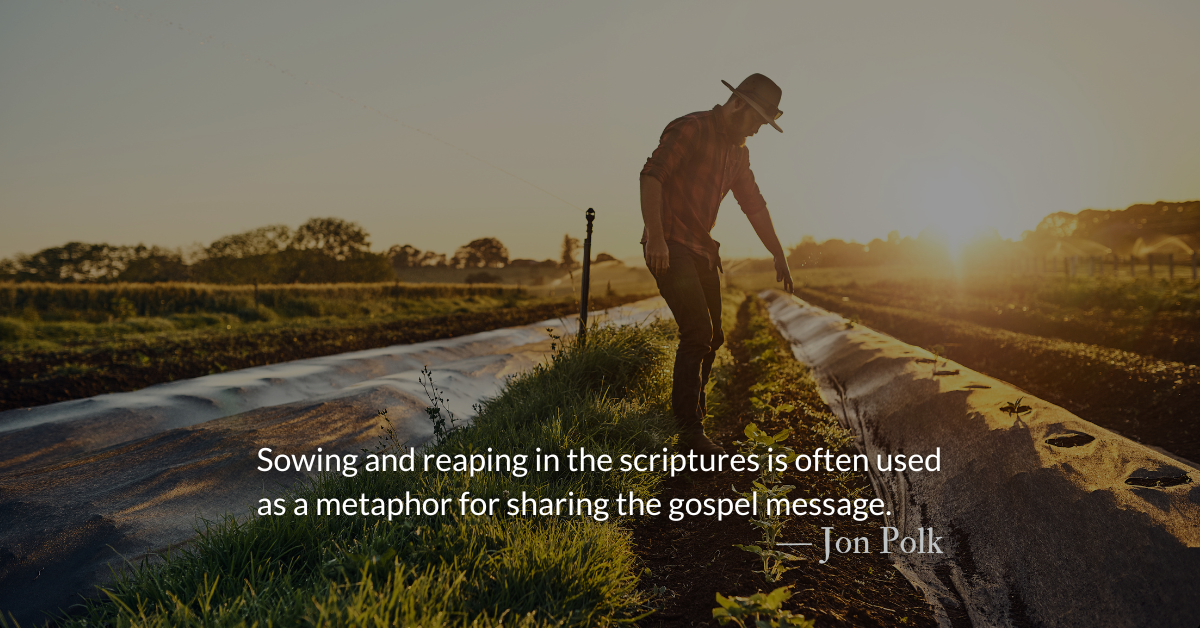
The singing evangelist Knowles Shaw would have us remember, however, that sowing and reaping in the scriptures is often used as a metaphor for sharing the gospel message.

When we come together as family and friends to celebrate and give thanks, we can easily get lost in the bounty of the provision and forget about the God who provided. Instead, may our thanksgiving be a testament to those around us of the faith we have in God’s providential care. May the sheaves we gather represent the impact our own generosity has on those around us.

Divine Hours Prayer: The Request for Presence
Let all who seek you rejoice and be glad in you; let those who love your salvation say forever, “Great is the Lord!” — Psalm 70.4

– From The Divine Hours: Prayers for Summertime by Phyllis Tickle.


Today’s Readings
1 Chronicles 16  (Listen 5:21)
Psalms 90 (Listen 2:03)

Read more about A Prayer of Harvesters
“The harvest is plentiful, but the workers are few…”
There is much work to be done, Lord.
Send us to the field—into our cities.

Read more about Supporting Our Work
Support from donors like you is vital to continuing our work. Join our donors to support ad-free biblical devotionals shared around the world.

Count Your Blessings – Hymns for Giving Thanks

Scripture Focus: Psalm 89:14-16
14 Righteousness and justice are the foundation of your throne;
    love and faithfulness go before you.
15 Blessed are those who have learned to acclaim you,
    who walk in the light of your presence, Lord.
16 They rejoice in your name all day long;
    they celebrate your righteousness.

From John: We are thankful to have more music-themed devotionals from Jon Polk this week. Leading up to Thanksgiving, Jon will take us through some hymns for giving thanks.

Reflection: Count Your Blessings – Hymns for Giving Thanks
By Jon Polk

Johnson Oatman, Jr. was born near Medford, New Jersey in 1856. His father, Johnson Oatman, Sr. was widely regarded as an excellent singer with a rich and powerful voice. As a young boy, Johnson Jr. loved to hear his father singing the great hymns of faith.

Johnson longed to sing like his father, but alas he was not gifted with similar vocal abilities. However, he still aspired to serve God with his life.

At the age of nineteen, Oatman joined the Methodist Church and began serving. Soon he was granted a license to preach the gospel and was ordained.

Although Johnson began to preach locally, he never received a permanent church assignment. He continued working for his father’s mercantile business, Johnson Oatman & Son, and took over after his father passed away.

Unable to sing like his father and lacking a permanent pulpit as a preacher, Johnson finally discovered at the age of 36 that he did have a musical talent: songwriting. He wrote prolifically, up to 200 songs a year. Over his lifetime, Oatman penned 5,000 hymns for the church.

Of those scores of hymns, undoubtedly his most famous composition, written in 1897, is the familiar Count Your Blessings. The song encapsulates Oatman’s own life experience.

When upon life’s billows you are tempest tossed
When you are discouraged, thinking all is lost
Count your many blessings, name them one by one
And it will surprise you what the Lord hath done

Count your blessings, name them one by one
Count your blessings, see what God hath done
Count your blessings, name them one by one
Count your many blessings, see what God hath done

This rollicking hymn soon became so famous that British evangelist Gipsy Smith once said, “Down in South London the men sing it, the boys whistle it, and the women rock their babies to sleep to the tune.”

How often do we think “I wish I could sing like her” or “If only I could share my faith like him” or “I’d love to serve the way they do”?

Oatman’s famous hymn is a reminder to us all that God has blessed us immeasurably and it is up to us to be attentive to the gifts God has given us.

Count your blessings, not your regrets. Number your joys, not your worries. Take stock of your value to God, not your personal disappointments.

Count your blessings, name them one by one, and see what God has done for you.

Divine Hours Prayer: The Call to Prayer
Bless the Lord, O my soul, and all that is within me, bless his holy Name.
Bless the Lord, O my soul, and forget not all his benefits. — Psalm 103.1-2


– From The Divine Hours: Prayers for Summertime by Phyllis Tickle.

Today’s Readings
1 Chronicles 15  (Listen 4:38)
Psalms 89 (Listen 5:29)

Read more about Praying Priestly Blessings
As followers of God today, a part of our identity is as carriers of the blessings of God that are intended for the world.

Read more about Supporting Our Work
End-of-year giving is often over half of our support for the year. Please consider becoming a regular donor either once a year or every month.

Beginning Again

Scripture Focus: 1 Chronicles 1.1-4
1 Adam, Seth, Enosh, 2 Kenan, Mahalalel, Jared, 3 Enoch, Methuselah, Lamech, Noah. 
4 The sons of Noah: 
Shem, Ham and Japheth… 

Psalm 79.1
1 O God, the nations have invaded your inheritance; 
they have defiled your holy temple, 
they have reduced Jerusalem to rubble.
2 They have left the dead bodies of your servants 
as food for the birds of the sky, 
the flesh of your own people for the animals of the wild. 
3 They have poured out blood like water 
all around Jerusalem, 
and there is no one to bury the dead.

Reflection: Beginning Again
By John Tillman

No act of judgment is the end of the story. God is always ready to begin again.

The banishment from Eden, the flood of Noah, and the destruction of Jerusalem are all referenced in our readings today. Each event is a horrific loss followed by God starting over with the faithful.

Chronicles comes from the pain of the Babylonian exile and looks to the past to see the future. The chronicler recognizes the need to return to the beginning to remember who God is and who humans are. Beginning with creation, the chronicler writes the longest genealogical record in the Bible. The chronicler tells the story of a God willing to start over, no matter how often we fail.

Adam lost Eden. Then he lost two sons. He lost Cain to the beast of sin that made him a murderer. He lost Abel to Cain’s rage. In Seth, God started over.

Noah lost his entire world. Then, he lost a son to an act of rebellion and shame. In Shem, God started over.

Psalm 79 cries out in pain and anger. The psalmist has lost home, the Temple, and many who died. Most likely written from Babylon immediately following the destruction of Jerusalem and the Temple, the writer mourns the loss of both places and people, both destroyed buildings and bodies.

The psalmist’s hot tears and stinging loss are not without hope. The writer foresees a time when mercy will come for the oppressed, freedom for prisoners, salvation for the dying, and judgment for the wicked. God, in the exile, is starting over. 

Most of us will never be physically exiled from our homeland or see our families slaughtered or enslaved. We endure other forms of exile and suffering. Losses of friendships, communities, and broken institutions feel like a death. On top of these losses, we have seen abuse and death within our communities of faith, our cities, and our nation. We can all join the psalmist’s lament, “How long, Lord?”

The psalmist assures us that God hears our groans, complaints, cries, and distress. The chronicler assures us that, no matter what has been lost, God is already at work to restore, repair, rebuild, and rescue.

There is nothing humans can ruin that God cannot restore. Are we ready to begin again?

Divine Hours Prayer: The Refrain for the Morning Lessons
Blessed be the Lord! For he has shown me the wonders of his love in a besieged city. — Psalm 31.21


– From The Divine Hours: Prayers for Summertime by Phyllis Tickle.

Today’s Readings
1 Chronicles 1-2  (Listen 11:18)
Psalms 79 (Listen 1:50)

Read more about From Your Nothing…Something Beautiful
Give your scarcity, your vacuum, your past to Jesus. Sense him hovering over it with you. From your nothing Jesus can make something beautiful.

Read more about Lasting Revivals and Normal Idols
Josiah cleansed Israel and Judah from top to bottom, but the next generation went bottom up. The changes didn’t stick. Why?